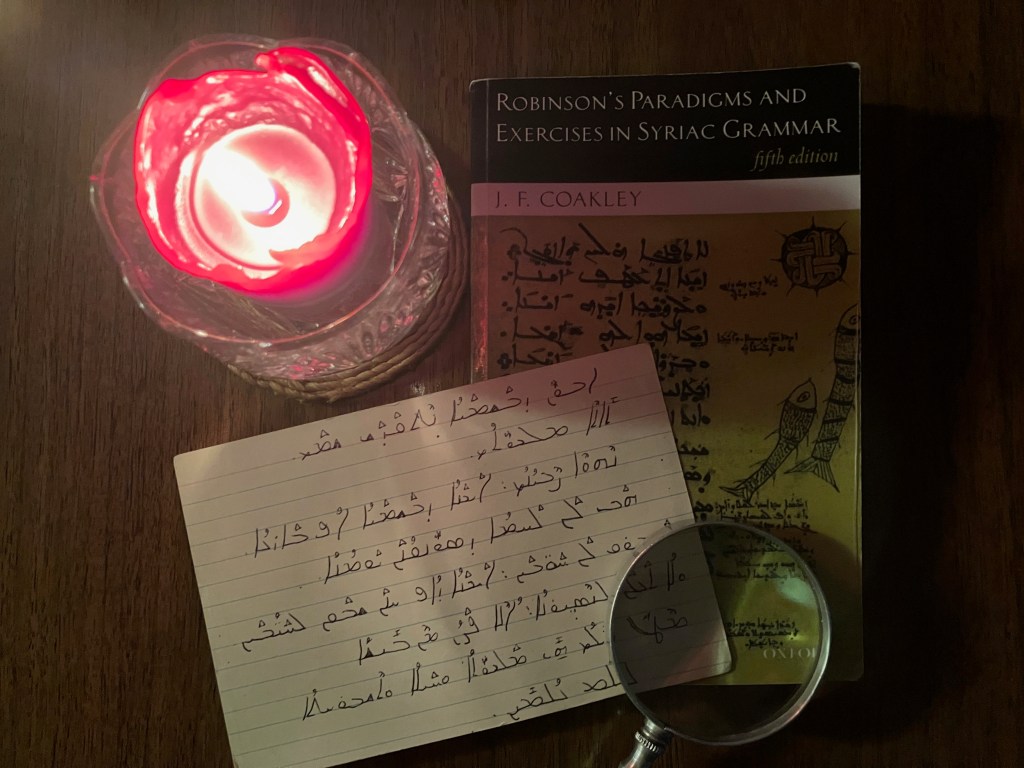
The Limits of Sense

photograph (c) Katherine Brown

His delight shall be in the fear of the Lord. He shall not judge by what his eyes see or decide by what his ears hear, but with righteousness he shall judge for the poor and decide with equity for the oppressed of the earth; he shall strike the earth with the rod of his mouth, and with the breath of his lips he shall kill the wicked.

Isaiah 11:3-4, from 11:1-10 [NRSVUE] (Lectionary text for Dec. 4, 2022)

Then the eyes of the blind shall be opened, and the ears of the deaf shall be opened; then the lame shall leap like a deer, and the tongue of the speechless sing for joy.

Isaiah 35:5-6a, from 35:1-10 [NRSVUE] (Lectionary text for Dec. 11, 2022)

It is the seeming rejection of sense perception that catches me when I read Isa 11. Not the ‘wolf living with the lamb’ or any of the peaceable kingdom images. Not the ‘shoot’ coming from the ‘stump of Jesse,’ the ‘little child’ leading; the promised ’root’ Paul claims as Christ [Rom. 15:12]. It’s the fact that this coming one shall not judge by his eyes nor decide by his ears [Isa 11:3].

That forswearing of senses strikes at odds with the prophet’s earlier proclamation to ‘Make the mind of this people dull, and stop their ears, and shut their eyes’ [Isa 6:10]. If sensory deprivation is prophesied as the LORD’s judgment, and restoration of vision and audition is prophesied as the LORD’s coming grace [Isa 35:5-6], then how am I to understand the mission of this promised shoot? The one who ‘shall not judge by what his eyes see, or decide by what his ears hear’ but will judge with righteousness and decide with equity [Isa 11:3-4]? Isaiah 11 sets sight and sound in opposition to righteousness and equity, complicating the idea of a simple progression from blindness to sight. This text describes vision and audition as senses whose usefulness is suspect.

I compare translations; consult lexicons; search scholarly articles. The shoot from the stump of Jesse shall ‘delight in the fear of the LORD,’ or perhaps shall ‘sense’ in the fear of the LORD (as the JPS translation suggests). ‘Fear of the LORD’ is the sixth of the spirit-gifts which shall rest upon him: wisdom, understanding, counsel, might, knowledge and fear of the LORD [Isa 11:2]. A variety of values (near-synonyms?) for that which should undergird right judgment. Not the seeing of eyes nor the hearing of ears but fear of the LORD, the ‘beginning of wisdom’ [Prov. 9:10].

Does it seem backwards to describe knowledge as a spirit-gift, rooted in reverence? Do we trust what is taught or do we conceive of learned interpretation as less reliable than direct perception? Sight, sound, smell, taste, touch. Our senses are how we apprehend the world around. Our senses are the basis of our witness of and in the world. We know what we saw, we declare, we know what we heard.

Except we don’t. Not really. Sight is interpretation. When we look at light and dark, lines set on a page or shapes shifting in the world around, we don’t just see but interpret the form and the movement. More than that, until we learn it, we may not even see it.

This is what I learned from learning Syriac. Syriac script is consonantal. Vowels are written as tiny marks added around the consonants like some sort of decorative surround. Syriac vowel shapes are varied, and when first I encountered them they seemed to me random squiggles. They were to me literally indecipherable. I consistently floundered in my guesses as to which vowel was which until finally the professor said, Can you not see the letters? She enlarged the pages double-sized so that the squiggles stood out clear to my sight. Only then could I see: each was distinct, had a different shape, stood for a different sound. I had to learn the details writ large before I was able to see them writ small.

I couldn’t see them until I knew them.

We don’t know what we see; we see what we know.

We cannot judge by our own sight until we are taught how to see.

The prophet does not reject sense perception so much as require its right re-ordering, calling us to learn righteousness and equity. Instruction is promised; the Word will flow from Zion [Isa 2:1-5]; calling people to walk God’s holy highway and to sing joy [Isa 35:8-10].

The sprig sprung from Jesse’s line is like the ‘child who has been born for us’ [Isa 9:6] or the ‘servant’ whose tongue is taught [Isa 50:4]. The church reads these as Jesus, who told those who asked to ‘Go and tell what you hear and see’: blind eyes seeing, deaf ears hearing [Matt 11:4-6]. (Jesus’ juxtaposition of sense terms suddenly makes me wonder if he thought by his answer to open the ears and eyes of those who had asked!)

The sprig sprung from Jesse’s line may be read as Jesus. Yet reading Jesus in this text does not exhaust its possibilities. It promises not only ultimate judgment and ultimate restoration, but also proposes a way to wait in the meanwhile. I cannot see and hear and study to save myself. But I can be reminded that my sight and hearing are limited by what I know and re-called to look and listen and study to be in relationship with the world. Copy righteousness and equity over and over until their shapes are fixed in my hand and my eye. Recite fear of the LORD with my lips and mouth. Walk God’s instruction with my feet. Practice sight and hearing and pray sense enlarged with ‘the knowledge of the LORD as the waters cover the sea’ [Isa 11:9].

Night Hearts

Strengthen the weak hands, and make firm the feeble knees.  Say to those who are of a fearful heart, “Be strong, do not fear! Here is your God. He will come with vengeance, with terrible recompense. He will come and save you.” Then the eyes of the blind shall be opened, and the ears of the deaf unstopped; then the lame shall leap like a deer, and the tongue of the speechless sing for joy.  For waters shall break forth in the wilderness, and streams in the desert; the burning sand shall become a pool, and the thirsty ground springs of water; the haunt of jackals shall become a swamp, the grass shall become reeds and rushes.

Isaiah 35:4-7; excerpt from text for Sunday December 15, 2019, Isaiah 35:1-10

The sound blares, breaking the night.  The dark that had come as a comforting unity as soon as I turned off the lamp is split into bits.  I find myself standing beside my bed, phone in my hand, bare feet somehow colder than the bare floor, with no conscious recollection of how I went to vertical from prone.  It is not good news.  It never has been, these calls that come in the dark.  This time, at least, I am being told, not summoned.  I can return to my bed, which is still warm.  I can pull the covers over.  I can fall back asleep.  Except, of course, I cannot do the last.  Not immediately.  I am still too aware of my heart’s pounding.

‘Say to those of fearful heart,’ the prophet addresses the people.  The opening imperative is plural, ‘You, all of you, say …. ’  The once-removed addressees are plural as well:  all of those whose heart is hastening.  Those who need the word are multiple, yet they are one in the characterization of their shared heart.  It is not in the Hebrew, ‘fearful’:  the word used to describe the heart is different than the verb in the command not to fear.  Their heart is ’hasty,’ ‘swift,’ ‘rash,’ or ‘impetuous.’  (The alternate glosses come from other verses where the same verb is used.).  Their heart is racing.  Whether the news come is unexpected or long-dreaded or still only anticipated, not yet here, they find themselves standing in the cold dark, heart pounding, with no clear recollection of how they got there nor a clear vision of what comes next.  

The prophet gives them the latter, at least.  The prophet promises their God coming with ‘terrible recompense’ to save.  Rather, the prophet commands the people (‘You, all of you, say’) to say the word of saving.  Not just to save generically, generally, but to ‘save you.’  You plural.  You whose heart is racing in apprehension, in reaction, in fear.  Be strong.  Do not fear.  The prophet foretells sight and hearing, leaping with the height and grace of a deer, songs exultant rising to the sky.  The promise is wonderfully, deeply embodied — this salvation is not something away from this world but something that transforms our experience of this world, something that transforms the world itself.  The desert springs with water.  Burning sand becomes a pool.  Human and earthly reviving are woven in together, as if each — both — are necessary parts of the exact same whole.

The transformation has not come.  Not yet.  Nor does the prophet say that it has.  Eyes shall be opened; ears shall be unstopped.  Shall be so — surely so — just not yet.  But even to say it coming marks a change.  The prophet previously heard from the LORD regarding the people’s heart and eyes and ears:  the heart made fat, or dull, the eyes shut, the ears stopped (Isa 6:10).  Some 30 chapters on, that period of incapacity is coming to a close.  This heart is not dull, insensitive, unable to respond.  This heart pounds, races, in reaction to what has come.  The people are becoming again awake.  Awake again to know their need.  Awake again to given a word of renewal of sight and hearing and dancing and song, the desert itself rejoicing and the dry land made glad.  All creation redeemed by its creator.  Be strong.  Do not fear.

I don’t live in a desert.  And, in truth, the awareness of my own heart’s racing is (again) too new for a word of comfort to be heard, for the promise of saving to feel near.  But it matters, yet, to know that the word is said, that God’s purpose has turned from one phase to the next.  As if I and others might — in time — be turned with it.

I walk on the paved path by the creek.  Sometimes, the water seems glass-still.  But the water cannot be still.  This is a creek, not a pool.  Sligo flows to join the Northwest Branch, and together they run into the Anacostia which flows into the Potomac which joins the Chesapeake which itself flows into the ocean.  I look, and I see glass rather than motion.  But the water cannot be still.  There must be motion because this is a creek.  I have to stop walking to see it.  I have to stop walking and look a long while at the water’s glassy brown color and the leaves floating atop it.  Only when I myself have stopped walking and have looked and have fixed my sight on the leaves, then I begin to be able to see:  the leaves are moving; I can measure their subtle progress against the bank.  But I had to look long to realize it was happening all along. The word of the LORD is told in the motion of the water.

Yes, my heart is pounding.  Yours is racing too, for whatever night noise brought you awake, for whatever dread outcome has occurred in actuality or expectation.  It is awful.  And it is not the end.  It begins the summons of the LORD — God speaking to all of us, for none among the people (not even the prophet) have not known that fear, that grief, that ache.  So all of us are called by God to strengthen the weak hands, firm the feeble knees, and share the news with all of us — each other — we whose hearts race and flutter and pound in our chests:  Be strong, do not fear.  The LORD our God is coming to save.  The movement is subtle but it is sure.  You do not need to sing, not yet.  But know that — soon — creation itself shall sing for and with you.