Resistance Springing

(c) Katherine E. Brown

You shall answer, and you shall say, ‘… Now, see: I bring in the first fruit of the ground which you gave to me, LORD.’ You will put it before the LORD your God, and you will bow low before the LORD your God, and you will rejoice in all the good which the LORD your God gave to you and to your house, you and the Levite and the alien who is among you.

Deuteronomy 26:5a, 10-11; see Deut 26:1-11 NRSVUE

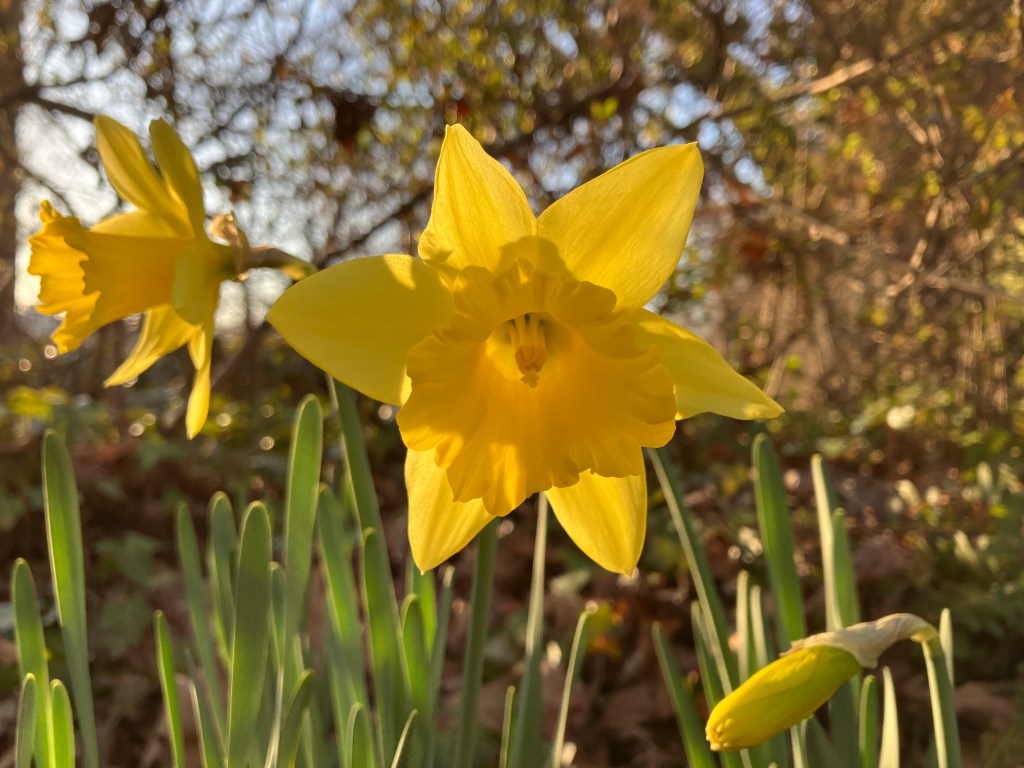
I am extra aware of the light the first week after the clocks spring ahead. It’s not just that my alarm rings earlier, as measured by the sky; it is the strangeness of the afternoon light: clear at an hour when I am expecting its tone to have warmed with the sun’s lowering. The sun keeps its own time still, yet its rhythm, too, is shifting, each day longer by minutes. By the end of January, we can walk in daylight as late as 5:30; as late as 6 by February’s end. Changing the clock does not itself add to the day, but it does make plainer what has been taking place already, making the incremental seem sudden, and more entire. Everything seems to have come on at once. Red buds are visible on the maple tree. Snowdrops’ slender white flowers are now joined by yellow aconite and purple crocus and hellebore in muted colors of cream and mauve. The withies of winter jasmine have grown green and put out yellow flowers. I look out the back window and see daffodils madly daffodil-ing — cups and petals unfolded and shining golden in the sun.

These buds and blooms are the first fruits of spring, somehow made more noticeable by the admittedly artificial, and frankly sometimes-irritating, practice of changing our clocks. Shifting my rhythm this way shifts something in my sight. Spring’s good is sprung. Daffodils dance yellow in the March wind, and their apparent joy insists upon being rejoiced-over.

Deuteronomy’s first-fruits are not the bright blooms of the neighborhood but the first of the season’s harvest on which the people will depend for the rest of that year and until the next year’s harvest is ripe. These first fruits are not to be hoarded nor privately gloated over. These first fruits are to be given back, that the whole harvest may be received as gift.

I appreciate the precision of the liturgy in this text: directions for posture and gesture and scripted speech. The first-person recitation places each one who recites it in continuity with the vulnerable father, the oppressed stranger, the one heard and seen and saved and brought in to a land from which first fruits would grow — these very fruits, brought here in this basket. To practice this liturgy is to be reminded that the ‘exceptionalism’ of God’s people is not inherent in themselves but in God, the giver of all the good.

Read on. The liturgy is larger than the scripted gestures and declarations in front of the altar. The next step in the practice is to ‘rejoice in all the good the LORD your God has given you’ — the very good which the one-who-trusts-flesh cannot even see? Rejoice in all the good along with the portionless priests, with the alien who is among you. Not sharing ‘yours’ with ‘them’ but receiving with them the LORD’s giving to all.

Rejoice! This injunction brackets and punctuates the core of Deuteronomy [see 12:7, 12, 18; 16:11, 14, 15; 26:11]. God’s people are commanded to bring offerings at set times, to eat and to be glad in the presence of the LORD and the company of the vulnerable. Gladness as scheduled practice. Make the feast not for being already glad; become glad in the making of the feast.

Joy may seem an unrealistic demand, even unkind in the context of these days. (How can joy be expected in the face of so many summons to fear?). Then I remember the text context of these commands to joy: the people are yet in the wilderness, that time of turmoil and fear and traumatic becoming. Even so, even then, even here, God’s people are given the command to rejoice. The practice of joy as the distinctive characteristic of God’s people. Joy multiplied in the making of it. Wilderness resisted in delight dancing and insisting on being rejoiced-with.
Testimony in the Wilderness

(c) Katherine Brown

“Moses descended Mount Sinai, and the two tablets of the testimony were in Moses’ hand in his descent from the mountain. Moses did not know that the skin of his face shone from his speech with [the LORD].”

Exodus 34:29; See Exodus 34:27-35 NRSVUE

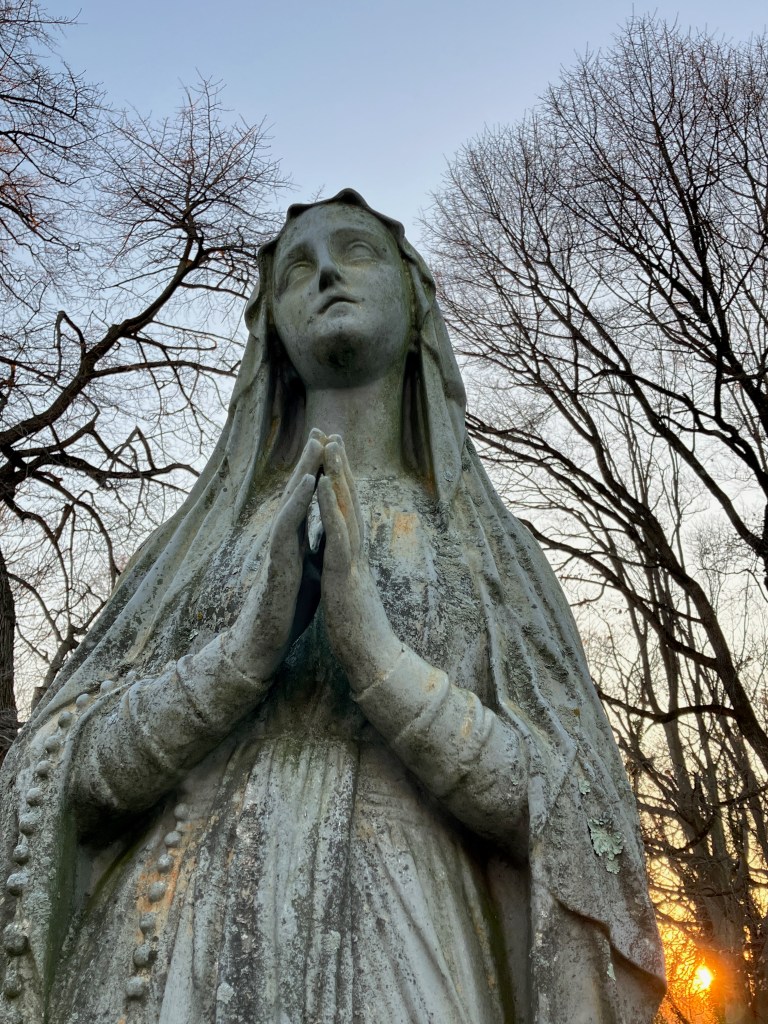
The wind is wild tonight. I sit at my desk upstairs and hear it roar through the trees. Do I hear the creaking of the trees themselves? Does the house shudder slightly as another gust hits it? Something outside crashes loudly down. It’s too dark to see what.

The wind unsettles me. To be fair, I am already unsettled. Too much these weeks do I lurch from news report to news report, calming myself each time with recourse to countering commentary. (Also dark chocolate.) But these means keep me bracketed to meaning as defined by this world. Even opposing empire, I am allowing empire to define the terms of engagement.

With difficulty I wrest my mind from the wind’s violence to Exodus 34: Moses transfigured. I have sat with this text before, focused on the transformative intimacy of Moses and the LORD. Now I feel its larger context of wilderness, of people terrified and mourning and longing to be led into new life, of trauma.

Exodus 34 is a reprise of Moses’ earlier ascent to receive from the LORD stone tablets with the teachings and the commandments (Exodus 24:12-18). Then also Moses had been up there forty days and forty nights. Meanwhile, at the base of the mountain, the people had seen ‘that Moses delayed to come back down’ (Exod 32:1) and responded with the desperate anxiety of an abandoned child. They demanded a god to go before them. Aaron made the Golden Calf, and the people made an unholy festival (Exod 32:2-6), and the LORD made Moses go back down the mountain with the two tablets of testimony, God-carved and God-inscribed. God’s anger had blazed forth, ready to consume, but for Moses standing in the breach (Exod 32:7-14), identifying himself as one of God’s own, not God’s only own. At the end of a dance of judgment and mourning (32:15-33:11), request and response (33:12-23), the LORD said to Moses, ‘Now, carve two tablets of stone like the first, and I will inscribe upon the tablets the words that were on the first tablets which you shattered’ (34:1). A second summons. A second ascent. A second span of forty days, after which Moses descends, shining.

In Exodus 32, the people’s sight of Moses’ absence so consumed them that they rushed to fill it. In Exodus 34, the people see in Moses’ radiance the presence of God.

The text tells that Moses did not know before it tells what Moses did not know. Moses doesn’t need to know his face shines. The people do. They have been oppressed by empire; terrified by wilderness. Maybe they’d imagined, leaving Egypt, that the road to the place God had promised would be straight, that any ascent would be so carefully graded that progress would be steady — that they could walk it without losing pace nor heart. Exodus tells a different story: a series of complaints and protests, of turning and returning. Wilderness life is precarious. God’s people know it so. They need to know it so. We need to know it so. So that they — we — can learn the only presence that will sustain life. Can leave space for it to shine, to speak.

This feels a wilderness time. My surprise at this feeling — or at its pain — is to me convicting. It reveals my mistake in imagining that the journey to kingdom living would be steady. That progress would be stable. Incremental. Within my control. As if control was ever meant to be mine. As if stability, rather than righteousness, is God’s priority. Have I (have we?) imagined myself ‘good people’ and forgotten the call to be ‘God’s people’? Goodness is a shallow cup. God is an inexhaustible well. Terrifyingly deep; ultimately sustaining.

Pray presence at the center. Not the small flickering that speaks of itself, but the great radiance that — even unknowing — tells God. Attend to the light; heed the speech; drink of the source. The stance on any particular issue may be the same; the strength will be greater.

Pray to see, pray to be, God’s testimony even, or especially, in this wilderness.

Creek’s Gleaming

(c) Katherine E. Brown

Blessed is the man who trusts in the LORD, and the LORD will be his trust.
He will be as a tree transplanted upon water, and upon a stream he will stretch out his roots. He will not fear [see] when heat comes in; his leaf will be green. And in the year of drought, he will not be anxious, and he will not leave off making his fruit.

Jeremiah 17:7-8. See 17:5-10 NRSVUE

Light stays later these days but even so is fading when Paul and I set out for our walk. We go down to Sligo, needing the solace of water. We have the path nearly to ourselves this weekday evening. Walking. Some talking. More looking. The ground beside the path is soft; the grass is winter-bleached and strewn with last season’s leaves. Trees grow near the creek, some fallen across it. We stand a while on the bridge, watching the water slip between banks tangled with brush and vines.

I look at the water and listen to Jeremiah in my head. Jeremiah 17 pairs, and contrasts, the one who is cursed and the one who is blessed. The term used for each is the same, “champion” or “strong man.” They are not distinguished in innate vigor or prowess but in where they place their trust: whether in flesh or in the LORD. The one whose trust is the LORD will not cease making his fruit, Jeremiah says. Despite the drought, the heat, the salt of news in print or online or email inbox, there is fruit to be borne. Fruit specific to that one’s making, as there is fruit specific to mine.

This text has been to me as a drink of clear water when I have felt parched these last weeks. Lift it to my lips and tip the bowl of it. Sip its promise; let it fill my mouth, soothe the dry tissues. Swallow the words and feel the refreshment of them running down my throat. Then, revived by that first effect, drink of the text more deeply still. Plod my way through the Hebrew, word by word. Let the awkwardness of my translation catch my attention, focus my thought, in the same way that uneven ground makes me more aware of my step as I walk.

The one who trusts in the LORD, whose trust is the LORD, that one does not “fear” when heat comes in. That is what is written in the Hebrew: “he will not fear.” But in the margin is an ancient alternative: “he will not see.”** The NRSVUE reads the word as “fear”; the JPS reads it as “see” (JPS “sense”). Surely “fear” is the right translation, I think. It is the better choice for not denying the reality of drought, the risk of desiccation. It does not ignore the trouble but states the LORD is water regardless: roots stretch out; leaves green, fruit is made.

Then, thinking on, I see the symmetry in the alternate translation, the balance in its opposition: the one whose trust is flesh will not “see” when good comes” (17:6); the one whose trust is God will not “see” the heat (17:8).

Read the double-possibilities as deliberate wordplay: expressing the inversion of attitudes and outcomes as well as the relationship between vision and fear. Translating “see” reminds that the bases of trust — flesh vs. the LORD — oppose each other, reverse outcomes: as the one will not see good; so the other will not see heat. Yet translating “fear” keeps also in view that the difference in their vision is the right trust, including the right fear. Because the blessed one trusts in the LORD — has the LORD as trust — because that one does not fear the heat, he will see the good that comes in, he is able to see the good that comes in. Fear narrows vision, limits and misleads sight. Trust restores it. The scorching heat, desert drought, trouble looming over, these are real and terrible, but these are not entire. Good comes in its own and awesome glory. The one whose trust is the LORD will see it. And in the meanwhile makes the fruit that is peculiar to that one’s making.

Paul and I are walking by Sligo Creek. Sky fades to softness and even so, the creek gleams. Flowing water reflects the darkening tangle of trees and brush, yes, and also the faint pink cast of the setting sun, and the pale-water blue of the sky. Dusk draws in, and still the creek shows light, flows liquid silver, even amid the darkening.

Drink deep of the LORD, the living water. Stretch out roots to see the good, green your leaves, make the fruit that is yours to make.

**The two words are close in the Hebrew. The “Ketiv/Qere” notes reflect ancient reading tradition.

The right use of fear

Even though I walk through the darkest valley,
I fear no evil;
for you are with me; 
your rod and your staff -- 
they comfort me.

Psalm 23:4; from Psalm 23, lectionary text for Sunday, March 22, 2020

The fear of the LORD is the beginning of wisdom, 
and the knowledge of the Holy One is insight. 

Proverbs 9:10

Thinking much about fear this past week, particularly the relationship between fear and faith.  I’m not the only one.   The Washington Post reports that in a certain Bible app, ‘searches for “fear” went up by 167 percent last week, and “fear not” by 299 percent.’*   

Institutions throughout my area — including the university where I teach — closed and moved work online.  Churches closed too.  More accurately, church buildings closed.  ‘Church’ remained open, with the community’s worship and prayer and study moved online.  News stories and social media feeds started covering this aspect of the coronavirus as a distinct thread within the larger tapestry of the new social pattern COVID is creating.  Of the various slants relative to the closing of churches, one that continued to recur was the tension claimed between fear and faith.  Most negatively, the relationship between fear and faith was presented as an intrinsic opposition, so that failure to gather physically for worship was failure of faith in God, elevating the power of the virus over the power of God.  In a more benign form, fear was admitted as natural, a human condition that we could offer to the LORD in trust of God’s comfort and cure.

‘Fear not,’ God repeatedly instructs, from Genesis (15:1) through Revelation (1:17).   ‘I will fear no evil,’ the psalmist sings, in laud and thanks of the LORD’s presence and comfort.   

But:  ‘The fear of the LORD is the beginning of wisdom, and the knowledge of the Holy One is insight.’  The proverb offers fear in parallel with knowledge, not as something to be avoided. 

Fear does not oppose fidelity.  Rightly ordered, it is part of it.

Fear may be irresponsible or destructive — panic that destabilizes and debilitates individuals and communities.  Yet I wonder whether our fear of fear, so rooted in our national ethos (‘We have nothing to fear but fear itself,’ FDR famously said) is depriving us of an important learning about ourselves as creatures and our place in creation.  Fear reminds us that we are not in control.  The Bible reminds us that we were never meant to be in control.  Made in the image and likeness of God, yes; given ‘dominion’ over creation, yes.   Just ‘a little lower than God,’ yes.  But ‘like’ and ‘lower than’ God.  Not God.  We were never meant to be God.  Fear reminds us that we are limited. Fear may allow us to recognize and admit, again as if for the first time, the power that is outside of us, the power that is other, the power that is beyond.

Perhaps this is the value in the practice of fear.   Perhaps this is the lesson of a time such as this.  The scope of the risk is unknown, at this point unknowable.  We are required to acknowledge our ignorance and to admit our finitude.  Even — effectively — forced to admit the fear that is the shadow side of so much of our bright life, the worry both quotidian and ultimate that we hide under the thrum of busy-ness, the hectic pace of work or play, the anxiety that comes out only sometimes, in the wee hours of the night when the surrounding dark seems vast and terrible.  Daybreak comes, we push the night terrors down and away, and we spend the hours of light — again — acting as if we are in control, which pretense has as its implicit corollary, that we are God, or at least that we know God already so perfectly as to be able anticipate and respond to every circumstance.

The current pandemic proves the power of this virus.  Fear of it is not faithlessness.  Fear may be, instead, the beginning of the beginning of wisdom.  As we acknowledge the fear of what is finite, as learn to revise our own actions in response to its power — a power as impersonal as a wave — we may begin to realize how to practice the fear of what is ultimate and infinite.  Of Who is ultimate and infinite.

Fear does not oppose fidelity.  Rightly ordered, it is part of it.  It has the potential to teach. As we learn, may we be drawn further on and in to deeper and dearer relationship with God.

‘The fear of the LORD is the beginning of wisdom, and the knowledge of the Holy One is insight’

*The Washington Post, ‘Worship goes virtual in age of social distancing,’ print 3/21/20

Night Hearts

Strengthen the weak hands, and make firm the feeble knees.  Say to those who are of a fearful heart, “Be strong, do not fear! Here is your God. He will come with vengeance, with terrible recompense. He will come and save you.” Then the eyes of the blind shall be opened, and the ears of the deaf unstopped; then the lame shall leap like a deer, and the tongue of the speechless sing for joy.  For waters shall break forth in the wilderness, and streams in the desert; the burning sand shall become a pool, and the thirsty ground springs of water; the haunt of jackals shall become a swamp, the grass shall become reeds and rushes.

Isaiah 35:4-7; excerpt from text for Sunday December 15, 2019, Isaiah 35:1-10

The sound blares, breaking the night.  The dark that had come as a comforting unity as soon as I turned off the lamp is split into bits.  I find myself standing beside my bed, phone in my hand, bare feet somehow colder than the bare floor, with no conscious recollection of how I went to vertical from prone.  It is not good news.  It never has been, these calls that come in the dark.  This time, at least, I am being told, not summoned.  I can return to my bed, which is still warm.  I can pull the covers over.  I can fall back asleep.  Except, of course, I cannot do the last.  Not immediately.  I am still too aware of my heart’s pounding.

‘Say to those of fearful heart,’ the prophet addresses the people.  The opening imperative is plural, ‘You, all of you, say …. ’  The once-removed addressees are plural as well:  all of those whose heart is hastening.  Those who need the word are multiple, yet they are one in the characterization of their shared heart.  It is not in the Hebrew, ‘fearful’:  the word used to describe the heart is different than the verb in the command not to fear.  Their heart is ’hasty,’ ‘swift,’ ‘rash,’ or ‘impetuous.’  (The alternate glosses come from other verses where the same verb is used.).  Their heart is racing.  Whether the news come is unexpected or long-dreaded or still only anticipated, not yet here, they find themselves standing in the cold dark, heart pounding, with no clear recollection of how they got there nor a clear vision of what comes next.  

The prophet gives them the latter, at least.  The prophet promises their God coming with ‘terrible recompense’ to save.  Rather, the prophet commands the people (‘You, all of you, say’) to say the word of saving.  Not just to save generically, generally, but to ‘save you.’  You plural.  You whose heart is racing in apprehension, in reaction, in fear.  Be strong.  Do not fear.  The prophet foretells sight and hearing, leaping with the height and grace of a deer, songs exultant rising to the sky.  The promise is wonderfully, deeply embodied — this salvation is not something away from this world but something that transforms our experience of this world, something that transforms the world itself.  The desert springs with water.  Burning sand becomes a pool.  Human and earthly reviving are woven in together, as if each — both — are necessary parts of the exact same whole.

The transformation has not come.  Not yet.  Nor does the prophet say that it has.  Eyes shall be opened; ears shall be unstopped.  Shall be so — surely so — just not yet.  But even to say it coming marks a change.  The prophet previously heard from the LORD regarding the people’s heart and eyes and ears:  the heart made fat, or dull, the eyes shut, the ears stopped (Isa 6:10).  Some 30 chapters on, that period of incapacity is coming to a close.  This heart is not dull, insensitive, unable to respond.  This heart pounds, races, in reaction to what has come.  The people are becoming again awake.  Awake again to know their need.  Awake again to given a word of renewal of sight and hearing and dancing and song, the desert itself rejoicing and the dry land made glad.  All creation redeemed by its creator.  Be strong.  Do not fear.

I don’t live in a desert.  And, in truth, the awareness of my own heart’s racing is (again) too new for a word of comfort to be heard, for the promise of saving to feel near.  But it matters, yet, to know that the word is said, that God’s purpose has turned from one phase to the next.  As if I and others might — in time — be turned with it.

I walk on the paved path by the creek.  Sometimes, the water seems glass-still.  But the water cannot be still.  This is a creek, not a pool.  Sligo flows to join the Northwest Branch, and together they run into the Anacostia which flows into the Potomac which joins the Chesapeake which itself flows into the ocean.  I look, and I see glass rather than motion.  But the water cannot be still.  There must be motion because this is a creek.  I have to stop walking to see it.  I have to stop walking and look a long while at the water’s glassy brown color and the leaves floating atop it.  Only when I myself have stopped walking and have looked and have fixed my sight on the leaves, then I begin to be able to see:  the leaves are moving; I can measure their subtle progress against the bank.  But I had to look long to realize it was happening all along. The word of the LORD is told in the motion of the water.

Yes, my heart is pounding.  Yours is racing too, for whatever night noise brought you awake, for whatever dread outcome has occurred in actuality or expectation.  It is awful.  And it is not the end.  It begins the summons of the LORD — God speaking to all of us, for none among the people (not even the prophet) have not known that fear, that grief, that ache.  So all of us are called by God to strengthen the weak hands, firm the feeble knees, and share the news with all of us — each other — we whose hearts race and flutter and pound in our chests:  Be strong, do not fear.  The LORD our God is coming to save.  The movement is subtle but it is sure.  You do not need to sing, not yet.  But know that — soon — creation itself shall sing for and with you.