Prophet in Motley

Hoy! All thirsty ones, come to the waters!
And whoever is without silver, come, buy, and eat!
Come buy — without silver and without price — wine and milk!
Why do you spend silver for not-bread? And labor for not-satisfaction?
Hear! Hear me, and eat what is good, and let yourselves delight in rich food!
Stretch out your ear and come to me. Hear, and your very self shall live!

Isaiah 55:1-3a (see Isaiah 55:1-5 NRSVUE]

The prophet’s opening ‘Hoy!’ catches me. A loud call, a sudden summons. It echoes in my ears; I slew my head around as if I might see on the street the speaker I see in my mind’s eye: clad in bright motley, wearing some sort of jingly jester’s cap, clothes and stance and call all setting him separate from the streams of passersby, who step to avoid him and continue on their way.

Hoy! The prophet calls. Speaking inestimable abundance — buy without silver, eat and drink wine and milk and goodness itself. Invitation and question together challenge the world’s prices, turns them topsy-turvey. Why spend, why work, for that which is the opposite of life? (He would not mistake public service with ‘lower productivity,’ as if worth is denominated only in dollars.)

The prophet summons the thirsty — meaning everyone — to a table that seems entirely separate from the one at which the oligarchs sit and squabble, jostling for proximity measured in piles of silver. The prophet describes a different circle. Listen! he cries. Look! he enjoins. Hoy! The summons is urgent; the verbs all imperatives, and plural. Go, all of you, from the table at which sawdust not-bread is sold in exchange for silver. Come, all of you, and sit instead at the table on which bread and wine and milk and good things are set.

Oh, it’s not so easy. The table being fought over is not the table that ultimately matters, but in the here and now the bombast spills over and has consequences. (USDA cancels contracts; the hungry are harmed.) Response is required. The prophet reminds that faithful response is not partisan reenactment of scarcity but empowered by the perception of abundance.

Hoy! Prophet in motley. Now I’m picturing the street performer who juggles at the local farmer’s market. His audience comprises a gaggle of open-mouthed children, whose parents are more attuned to the glad awe on their offspring’s faces than the arcs of balls or clubs whirling through the air. But they’re paused. They are tuned to more than their own busy-ness.

That pause may be itself a beginning.

After all, how many heard the prophet when first he spoke? He was no central figure, around whom the world turned. He cried out a word in earshot only of some. (Seal the teaching among my taught-ones, earlier Isaiah had said [Isa 8:16], suggesting both the dearth of immediate response and the conviction that the proclamation’s power persisted.) Some heard and were taught, some spoke and taught others in turn. The prophet’s call, the people’s march: these have purpose. The large public acts are testimony and sign. Resistance to what is wrong and commitment to work towards right. Yet for all that rallies matter, they tend more confirming than transforming. Change I might effect comes in smaller, more connectional increments.

The farmers market juggler catches all the balls, makes a sweeping bow. The children find their voices, tug parents towards whatever’s next. Grown-ups strange to each other read each other’s faces, catch each other’s eyes — smile awareness of the spell, appreciation of the shared experience. A seed for further word to be spoken; from which relationship may be built; through which transformation be born.

Come. Your presence is the only price. Come and hear. Eat and drink and live.

Creek’s Gleaming

(c) Katherine E. Brown

Blessed is the man who trusts in the LORD, and the LORD will be his trust.
He will be as a tree transplanted upon water, and upon a stream he will stretch out his roots. He will not fear [see] when heat comes in; his leaf will be green. And in the year of drought, he will not be anxious, and he will not leave off making his fruit.

Jeremiah 17:7-8. See 17:5-10 NRSVUE

Light stays later these days but even so is fading when Paul and I set out for our walk. We go down to Sligo, needing the solace of water. We have the path nearly to ourselves this weekday evening. Walking. Some talking. More looking. The ground beside the path is soft; the grass is winter-bleached and strewn with last season’s leaves. Trees grow near the creek, some fallen across it. We stand a while on the bridge, watching the water slip between banks tangled with brush and vines.

I look at the water and listen to Jeremiah in my head. Jeremiah 17 pairs, and contrasts, the one who is cursed and the one who is blessed. The term used for each is the same, “champion” or “strong man.” They are not distinguished in innate vigor or prowess but in where they place their trust: whether in flesh or in the LORD. The one whose trust is the LORD will not cease making his fruit, Jeremiah says. Despite the drought, the heat, the salt of news in print or online or email inbox, there is fruit to be borne. Fruit specific to that one’s making, as there is fruit specific to mine.

This text has been to me as a drink of clear water when I have felt parched these last weeks. Lift it to my lips and tip the bowl of it. Sip its promise; let it fill my mouth, soothe the dry tissues. Swallow the words and feel the refreshment of them running down my throat. Then, revived by that first effect, drink of the text more deeply still. Plod my way through the Hebrew, word by word. Let the awkwardness of my translation catch my attention, focus my thought, in the same way that uneven ground makes me more aware of my step as I walk.

The one who trusts in the LORD, whose trust is the LORD, that one does not “fear” when heat comes in. That is what is written in the Hebrew: “he will not fear.” But in the margin is an ancient alternative: “he will not see.”** The NRSVUE reads the word as “fear”; the JPS reads it as “see” (JPS “sense”). Surely “fear” is the right translation, I think. It is the better choice for not denying the reality of drought, the risk of desiccation. It does not ignore the trouble but states the LORD is water regardless: roots stretch out; leaves green, fruit is made.

Then, thinking on, I see the symmetry in the alternate translation, the balance in its opposition: the one whose trust is flesh will not “see” when good comes” (17:6); the one whose trust is God will not “see” the heat (17:8).

Read the double-possibilities as deliberate wordplay: expressing the inversion of attitudes and outcomes as well as the relationship between vision and fear. Translating “see” reminds that the bases of trust — flesh vs. the LORD — oppose each other, reverse outcomes: as the one will not see good; so the other will not see heat. Yet translating “fear” keeps also in view that the difference in their vision is the right trust, including the right fear. Because the blessed one trusts in the LORD — has the LORD as trust — because that one does not fear the heat, he will see the good that comes in, he is able to see the good that comes in. Fear narrows vision, limits and misleads sight. Trust restores it. The scorching heat, desert drought, trouble looming over, these are real and terrible, but these are not entire. Good comes in its own and awesome glory. The one whose trust is the LORD will see it. And in the meanwhile makes the fruit that is peculiar to that one’s making.

Paul and I are walking by Sligo Creek. Sky fades to softness and even so, the creek gleams. Flowing water reflects the darkening tangle of trees and brush, yes, and also the faint pink cast of the setting sun, and the pale-water blue of the sky. Dusk draws in, and still the creek shows light, flows liquid silver, even amid the darkening.

Drink deep of the LORD, the living water. Stretch out roots to see the good, green your leaves, make the fruit that is yours to make.

**The two words are close in the Hebrew. The “Ketiv/Qere” notes reflect ancient reading tradition.

A Hope of Woe

(c) Katherine E. Brown

And I said, ‘Woe to me! I am lost! For a man of unclean lips am I, and in the midst of a people of unclean lips I dwell, yet the King, the LORD of Hosts, my eyes have seen!’

Isaiah 6:5 [see Isaiah 6:1-13, NRSVUE]

In this season of headlines blaring crises and woe, I am avoiding Isaiah 6. It is unnerving to read of cities laid waste and houses uninhabited and the ground (‘adamah’) itself desolate, burned-over, bereft of its God-banished humans (‘adam’). It is unnerving to read of this expected destruction when the headlines seem to report so much of the same: not thoughtful husbandry of resources, careful culling of dead trees or pruning of unhealthy growth, but the slash and burn of an entire forest, heedless of where trees and branches fall, uncaring that the damage ripples beyond the immediate crash. Is there no good to nurture? In our time? In Isaiah’s? Where is the end? What is the goal?

To my ear, God’s tone is implacable. The LORD does not bluster but aims straight towards God’s end. Calls for someone to go, to proclaim, and thereby to accomplish, the hardening of people’s hearts and eyes and ears, lest they should see and hear and understand and turn again to the LORD (Isa 6:9-10), the LORD who is source of healing (Exod 15:26).

How is it that God should want to prevent this? Should call for one willing to be the agent of this hardening? Does the prophet know what he is volunteering for? He cried ‘Woe!’ in seeing his sin — starkly visible in the light of God’s holiness — and, reading, I realize the prophet’s cry is not undone by the touch of that hot coal, seraph-carried to his lips. The coal comes with the word that his sin is covered over, his iniquity turned away, but not that there is no more “woe!’ For when the prophet, purified and emboldened to speak in divine counsel, hears the task for which he has just offered himself, he cries out again: ‘Until when?’ (Isa 6:10). And learns that the work is longer than his lifetime, is a work that he himself will not accomplish, nor see accomplished. It is a work larger than human possibility.

Is this why the LORD reserves it to God-self, forecloses the possibility of premature return? Lest the people, turning, imagine that they have cleansed themselves, healed themselves, can be trusted with total control? Those who join house to house and field to field (Isa 5:8), who “acquit the guilty for a bribe and deprive the innocent of his right” (Isa 5:23) — these may share a portion of what they call their own, may make edits around the edges and imagine it is their righteousness working. As if individual acts of compassion are sufficient substitute for just society. Not them. We, us. For this, too, is part of the passage: the prophet does not cry his first woe in repudiation of others’ sin but in recognition of his own, and in kinship with his people. Isaiah’s glimpse of God gave him truer sight of himself: not one set apart from his nation’s sinfulness but one who has a part in it. Isaiah is convicted to speak of himself and people as one, and seemingly stricken with equal parts horror and awe, Isaiah cries Woe! That recognition — not ‘them’ but ‘we ourselves’ — begins the process of cleansing, allows Isaiah to speak to God, and after that, to speak for God. Even as hard word spoken judged Isaiah as much as the earth’s kings to whom he was subject.

We cannot save ourselves. God knows this. Isaiah learns this. In the year that King Uzziah died, Isaiah saw The King, the LORD of hosts. Isaiah has seen and spoken with The King, yet Isaiah cannot prevent Uzziah’s grandson Ahaz from right-sizing his foreign policy, piously refusing to rely on God (Isa 7), sending to the foreign empire Assyria for aid. Isaiah cannot keep Judah’s king, who should have been as ‘son’ to God (Psalm 2), submitting to be ‘son and servant’ to Assyria’s king (2 Kings 16:7), setting a foreign altar in God’s own sanctuary (2 Kings 16:10-16).

Isaiah cannot prevent any of this. Isaiah’s work, it turns out, is not to prevent it (lest Isaiah imagine that his work was effective to save?) but to prophesy nonetheless. To proclaim what fidelity looks like, to decry injustice and evil and oppression — even to write a record of the protest, of the call, of the need for God, and to seal that writing as a sign to the future (Isa 8). That seal signs both that the people did not, could not, save themselves, and the seal signs that there will be salvation.

Our burning-over is destruction. God’s burning-over leads to new seeds opening. The proclamation meanwhile is part of the work. I am not expected accomplish it; I am not excused from proclaiming it. It is my work to acknowledge my sinful part in the larger human ‘we’ (not us/them, but only us, all of us ‘like God,’ but not ourselves God). Recognize that kinship, cry out the Woe!, then attest to the possibilities that God intends.

Isaiah sees the LORD’s presence filling the house, the LORD’s glory filling the earth, and writes the vision so that others too can be filled. Filled with awareness of God’s holiness, awareness of our lack, and awareness that there is work to which we are summoned beyond that first Woe! Work which may fill us with, and for, God.

Speaking Delight

(c) Katherine E. Brown

On account of Zion, I will not be silent.
On account of Jerusalem, I will not be still —
Until as brightness her righteousness goes out,
And her salvation burns as flame.

Isaiah 62:1 (my transl.); see Isaiah 62:1-5 NRSVUE

The lectionary repeats every three years, so I am again looking at this Isaiah text. Again pondering silence and speech, naming and re-naming, brightness and sight. Again wondering if and how there might be any news in this text so old. I’ve written on it already. Why write on it again? Why keep speaking the need to speak? Is anyone even listening, or are we all tired of the same old summons to righteousness, said as if we’ve made no forward motion in the last 70 years?

The lectionary repeats every three years, and sometimes the ancient text and the current calendar seem so in sync that that synchronicity itself speaks. This section from the prophet Isaiah is assigned for Sunday, the eve of Martin Luther King, Jr. Day, this year also the eve of the presidential inauguration. The concurrence of these two observances has its own awkward synchronicity. One looks back at the man who called the nation to ‘Stride Towards Freedom’ — urging us forward towards making real the ideals we ostensibly espouse. The other inducts into office the man who calls for greatness ‘again,’ said with a backward glance, towards some imagined former, now-lost, luster. Each attitude in its way acknowledges that where we are as a people is not where we are meant to be; they hold this conviction in common with each other. So too Isaiah, the prophet who looks back to look forward, modeling the insight that reiteration may be, after all, part of the point.

The oracle that begins in 62:1 is not beginning from scratch, after all. The last section of the prophetic book, Isaiah 56-66, is replete with call-backs to what had come before, renewing and extending God’s promises to God’s people. Not because life had been static since the promises first were proclaimed but because the proclamation had not yet been fully realized: life had lurched forward, and twisted sideways, and shifted again, and still there was more road ahead.

Time it was that God had declared that the time for silence was past — that time had come to to cry out like a warrior, like a woman in labor — that God was birthing something new in and for God’s people, turning ‘darkness into light’ (Isa 42:10-16). The context for those promises was war, exile, inestimable loss. God’s people had cried out their conviction of forsakenness — and God had reassured that the LORD had not forsaken, that God was returning to embrace, that Daughter Zion should again be a rejoicing bride (Isa 49:14-18; 54:6-8).

Fifty or 100 years on, some of those promises had been realized: official exile had ended; deportees had returned to the land of their origin; Jerusalem had been rebuilt. Yet not all returned. The rebuilt city was less than the remembered old. The rough places had not been made all plain nor the crooked straight; God’s glory had not yet shone so universally bright that all flesh rejoiced in seeing it together (Isa 40:3-5).

Creation’s joy may have burst forth at the anticipation of return, but some 70 years on, its song seemed too soon over (Isa 55:12-13). God’s people were divided. They quarreled. They had to be reminded yet again, to keep justice and do righteousness, that God’s salvation was drawing near, that God’s righteousness being revealed (Isa 56:1). The time for silence was long, long past (Isa 42:13-14). The time to cry out is not yet over (Isa 62:1). Words are required again, and still, until righteousness shines bright and salvation flames. God does not cut short God’s bringing-forth any more than a laboring woman stops her labor short of birth. The only way to go is forward. Not because progress has not been made but because it has not yet been fully realized.

Life lurches forward, and twists sideways, and slouches ahead again, and still there is more road ahead. We look back to get our bearings, align ourselves with the marks, and adjust our way. Until God’s promise is realized fully and completely: salvation aflame and righteousness shining bright and all flesh — all — rejoicing in present glory and bridal delight.

A skim coat of glory

photograph (c) Katherine E. Brown

“And now, thus says the LORD, the one who is creating you, Jacob, the one who is forming you, Israel.

You shall not fear, for I redeemed you; I called you by your name. You are mine.”

Isaiah 43:1 (my translation); Isaiah 43:1-7 NRSVUE

I’m sitting up late Friday night and glance at the window, get up to move closer and look more carefully. Did I see some movement in the air? Has snow begun? I peer through the windowpane towards the porch light of the house opposite. No snow. Not yet. Perhaps the quiver I saw was a trick of my eyes, or my imagination, or even just my desire. Wanting snow.

We are due for snow. More snow, I should say: we already had a good fall this week, over six inches, the first good cover we’ve had in a while. My own snow yearning feels silly to me. Still, I dearly want it to come, longing not so much for added inches as for seeing the air quivering with snow magic, the shining of it coming down to cover the ground. It’s the sight of it that makes my heart leap. Becoming made visible.

That’s what it is. It’s not just the way the world is changed by the covering white: the shapes of things softened and mounded under the snow; surfaces smoothed; the colors of things not snow-covered altered by being set against such whiteness. It’s the way the transformation itself is visible in time. I can watch the flakes flurry and dance in swirling descent, can see them set the first skim-coat of white on the ground, lay successive layers on the first. Brightness falls through the air, makes earth shine with light rich and strange, and this wonder unfolds in the right time for my own eyes’ perceiving.

That’s what I long for: to be able to see re-creation occurring, to watch and marvel at its grace. Who wouldn’t want to be see glory coming? To tremble at its awful weight and to find rest in its wondrous love. To know — bone-deep — that the wheel of time is turning on towards redemption. That the years are not waste. That the losses are not the end.

‘And now, thus says the LORD — .’ God God-self speaking. God speaking to those who had passed through waters, had walked through fires [Isa 43:2]. God speaking even to those who had lost homes and livelihoods and loved ones to flood or flame, to war or exile. Name it Babylon or Gaza, Helene or Palisades, or the quotidian inequities still inadequately redressed. God speaks in these contexts. God speaks to us.

‘And now, thus says the LORD, the one who is creating you, Jacob, the one who is forming you, Israel — .’ Scanning the Hebrew, I recognize the participles, re-read the text as creation on-going, as formation unfolding. Jacob-Israel. Me-us. Becoming created and fully formed even as already we are called by name, already we are redeemed. The paradox of this juxtaposition: our redemption complete; our re-creation coming yet to be.

Oh, there’s a web of connections here! God who declares the LORD his name, who gives his glory (‘kabod’) to no other [Isaiah 42:8], calls being-created-Jacob, being-formed-Israel, ‘precious’ and ‘honored’ (‘kabod-ed’) and ‘beloved’ [Isaiah 43:4]. God speaks of and to ‘all who are called by my name’ [Isa 43:7] — a call-back to v.1, where God calls us by our names. Now, v.7, we hear that to call us by our own names is also to call us of-God’s. ‘To my glory (that word again, kabod) I created them, I formed them (more call-back to v.1), also I made them.’

A web of connections to unspool. But maybe for tonight, I’ll go back to verse 1. To the promise of that paradox. That already we are redeemed even as we are coming yet to be. That God’s own glory is bound up in our becoming, and that as the LORD will not give God’s glory to any other, neither will the LORD give us up to any other end but God’s own. I may pray to see the aim more clearly in my context, but meanwhile there is the promise of the text to ponder, and in its heart to rededicate myself, notwithstanding all that I cannot see.

Paul comes upstairs, goes to pull the window shade. ‘Oh!’ he says, ‘It’s snowing!’ For this, I scramble out of bed and hurry to the window. I lean near and look out and up to the streetlight, and in its brightness, I can see it! Fine stuff shifting down, each pinpoint mote distinct. The air moves and shines and already there is a fresh skim coat of glory on the ground.

Becoming made visible.

Concert Season*

Candle procession. photograph (c) Katherine Brown

‘Therefore the Lord himself will give you a sign. Look, the young woman is with child and shall bear a son and shall name him Immanuel.’ … ‘which means, “God is with us.”’

Isaiah 7:14, excerpt from Isa 7:10-16 [NRSVUE] and Matt 1:23, excerpt from Matt 1:18-25 [NRSVUE]

The middle school does not have its own auditorium, so concerts are held at the high school. Tonight’s concert is chorus and orchestra. The auditorium is a cacophony of noise; talking, laughing. Students cavort; parents visit. Odd squeaks sound as one instrument is bowed, then another – individuals rehearsing the awkward bits, each of them alone, not yet in concert. Punctuating the chaos comes the tinkle of piano keys as the accompanist runs through the songs, adding a spritely rhythm to the random-patterned, rising-falling noise.

The chorus director gathers her brood onto the risers. There is some awkward stomping and giggling but no crashes. She sketches a movement with her hands, and the chorus begins to sing a scale – soft voices, vulnerable. On the other half of the stage, the orchestra director sets the beginning strings to tune; they scratch and squeak. The advanced orchestra waits, clustered in little groups, some kneeling backwards in their seats, chatting and laughing.

The concert begins with the chorus, continues with beginning strings. Then the advanced orchestra moves onto the stage.

The performers take their seats. They settle sheet music on the stands; they ready instruments. After a pause, a dark-haired girl — the first violinist – stands, tucks her violin under her chin, and draws her bow across its strings. A single note sings solitary. Is then joined by others, as bows are drawn across violins and cellos and a bass. The notes come in slightly different times and keys until the wavering dissonances are resolved and merge. The director enters, bows, lifts his baton, motions the music to begin.

I love that initiating note … the others that join…. The potential of all the music to come is held in that long-drawn not-quite-chorded note. There will be carols and dances and a concerto by Liszt. But first there is this note, offered up, fragile and tenuous and pregnant with possibility. As small and frail and potent as a baby born God-With-Us. A note begun sweet and solitary. A note rehearsed year after year, across seasons and generations, in different keys and rhythms, until all the instruments are added, and the dissonances drawn together, and the music swells in full power and one song.

Presence signed: God-with-us.

*originally written 2010; posted 2022

Standing before the king

photograph (c) Katherine Brown

In the third year of the reign of King Jehoiakim of Judah, King Nebuchadnezzar of Babylon came to Jerusalem and besieged it.  The Lord gave King Jehoiakim of Judah into his power, as well as some of the vessels of the house of God. These he brought to the land of Shinar, and he placed the vessels in the treasury of his gods. Then the king commanded his palace master Ashpenaz to bring some of the Israelites of the royal family and of the nobility …. The king assigned them a daily portion of the royal rations of food and wine. They were to be educated for three years, so that at the end of that time they could be stationed in the king’s court. Among them were Daniel, Hananiah, Mishael, and Azariah, from the tribe of Judah.

Daniel 1:1-3, 5-6, from 1:1-21 [NRSVUE]

Daniel, Hananiah, Mishael, and Azariah. Four youths from Judah (the Hebrew calls them ‘children’), ‘of the royal family and of the nobility … without physical defect and handsome, versed in every branch of wisdom, endowed with knowledge and insight, and competent to serve in the king’s palace’ (Dan. 1:3-4). The description of their good looks and amazing insight sounds swoon-worthy until you realize it’s a procurement order. Nebuchadnezzar, king of Babylon, has requested a bevy of these carried-off boys to be corralled, trained, and fed from the king’s own table so that they might in time ‘stand before the king’ (1:4, 5, 18).

To ‘stand’ is the idiom for service, a catch-phrase that can connect this text with last week’s, Elijah’s affirmation that he ‘stands before’ the LORD (1 Kings 17:1). The connection hints at what’s at stake for Daniel and his compatriots. They’ve survived the war. As they endure the captivity, they need to consider. Before whom do they stand? Israel’s God or Babylon’s king?

Babylon’s king is the overt actor. He laid siege to Jerusalem, carried off its treasures, ordered the boys be brought and trained and fed. Yet the chapter is bracketed with references to other kings: the king of Judah, which Babylon conquered (1:1), the king of Persia, which will conquer Babylon (1:21). The frame suggests the transience of earthly powers. Meanwhile, God’s power ‘gives’ Jerusalem into Nebuchadnezzar’s hand (1:2), ‘gives’ Daniel the favor and compassion of the palace master (1:9), ‘gives’ the four youths knowledge and skill in wisdom (1:17). God’s giving is stitched through the chapter, though God is not the actor strutting on the stage.

I wonder what of God’s presence was palpable to Daniel and Hananiah and Mishael and Azariah. Were they aware that God — who had given their homeland to an invader — would give them the favor and knowledge and skill to survive, to thrive in this strange place? What was it that sustained their commitment to stand before the God of Israel even while standing before Babylon’s king? What did they know, or hope? And when?

The chapter pivots at verses 7 and 8. The palace master ‘sets’ Babylonian names on these boys from Judah (1:7), and Daniel ‘sets’ his heart on not ‘defiling himself’ with the royal food and wine (1:8). It reads almost as if he’s shaken himself awake, becomes a speaking actor in the play rather than a prop shunted about the stage. Description gives way to dialogue, the negotiation of the ‘test’: ten days of vegetables (or maybe ‘seeds’) and water, after which Daniel and friends appeared so much haler than the other candidates that they were allowed to continue on their restricted diet. They are allowed to refuse to defile themselves.

The text never defines how the royal rations would defile. Suppositions are multiple. Perhaps the foreign food violated kashrut. Perhaps the king’s portion is imperial indoctrination. Perhaps the preferred rations echo the ‘seeds’ and ‘growing things’ of Genesis 1:29, as if Daniel and friends, carted off to the king’s gardens in Babylon, will to live as if in God’s garden of Eden.* Or the text is meant to evoke the water and manna of the wilderness: a daily sustaining and a test that leads to knowledge.** Or the text is determinedly indeterminate — staking itself on the explicit claim that this refusal is necessary to avoid defilement, and the demonstration of God’s giving, subtle but sure — while requiring continual wrestling with its possibilities. As Daniel and his friends had to live in the tension of their time, so do we have to live in the tension of the text, allowing it to resist any tidy resolution so that it can speak to our own untidy lives.

How do you know who you are in a setting where everything is not what it was?  How do you maintain identity when all around you is strange, even hostile?  How do you allow yourself to change without becoming strange to yourself?  How do you commit to God’s reign while subject to the powers of the world? This text invites us into the questions not by offering an answer so much as a process. It refuses to conflate God’s kingship and any other but recognizes, even magnifies, the tensions between. (The palace master may change the boys’ names from -of God to -of Babylon; the text itself refuses, uses the names that include God’s name.)

Shake yourself awake. See what’s at stake. Set your heart to stand before the LORD. Hope in God’s giving. Commit to the tension — that’s how the lines sing.

Faith feeds on commitment.

* Anne E. Gardner, ‘The Eating of ‘Seeds’ and Drinking of Water by Daniel and Friends: An Intimation of Holiness.’ ABR 59 (2011) 53-63.

** Michael Seufert, ‘Refusing the king’s portion: A reexamination of Daniel’s dietary reaction in Daniel I.’ JSOT 43(4) (2019) 644-660.

Concert Season*

Candle procession. photograph (c) Katherine Brown

‘Therefore the Lord himself will give you a sign. Look, the young woman is with child and shall bear a son and shall name him Immanuel.’ … ‘which means, “God is with us.”’

Isaiah 7:14, excerpt from Isa 7:10-16 [NRSVUE] and Matt 1:23, excerpt from Matt 1:18-25 [NRSVUE]

The middle school does not have its own auditorium, so concerts are held at the high school. Tonight’s concert is chorus and orchestra. The auditorium is a cacophony of noise; talking, laughing. Students cavort; parents visit. Odd squeaks sound as one instrument is bowed, then another – individuals rehearsing the awkward bits, each of them alone, not yet in concert. Punctuating the chaos comes the tinkle of piano keys as the accompanist runs through the songs, adding a spritely rhythm to the random-patterned, rising-falling noise.

The chorus director gathers her brood onto the risers. There is some awkward stomping and giggling but no crashes. She sketches a movement with her hands, and the chorus begins to sing a scale – soft voices, vulnerable. On the other half of the stage, the orchestra director sets the beginning strings to tune; they scratch and squeak. The advanced orchestra waits, clustered in little groups, some kneeling backwards in their seats, chatting and laughing.

The concert begins with the chorus, continues with beginning strings. Then the advanced orchestra moves onto the stage.

The performers take their seats. They settle sheet music on the stands; they ready instruments. After a pause, a dark-haired girl — the first violinist – stands, tucks her violin under her chin, and draws her bow across its strings. A single note sings solitary. Is then joined by others, as bows are drawn across violins and cellos and a bass. The notes come in slightly different times and keys until the wavering dissonances are resolved and merge. The director enters, bows, lifts his baton, motions the music to begin.

I love that initiating note … the others that join…. The potential of all the music to come is held in that long-drawn not-quite-chorded note. There will be carols and dances and a concerto by Liszt. But first there is this note, offered up, fragile and tenuous and pregnant with possibility. As small and frail and potent as a baby born God-With-Us. A note begun sweet and solitary. A note rehearsed year after year, across seasons and generations, in different keys and rhythms, until all the instruments are added, and the dissonances drawn together, and the music swells in full power and one song.

Presence signed: God-with-us.

*originally written 2010

The Limits of Sense

photograph (c) Katherine Brown

His delight shall be in the fear of the Lord. He shall not judge by what his eyes see or decide by what his ears hear, but with righteousness he shall judge for the poor and decide with equity for the oppressed of the earth; he shall strike the earth with the rod of his mouth, and with the breath of his lips he shall kill the wicked.

Isaiah 11:3-4, from 11:1-10 [NRSVUE] (Lectionary text for Dec. 4, 2022)

Then the eyes of the blind shall be opened, and the ears of the deaf shall be opened; then the lame shall leap like a deer, and the tongue of the speechless sing for joy.

Isaiah 35:5-6a, from 35:1-10 [NRSVUE] (Lectionary text for Dec. 11, 2022)

It is the seeming rejection of sense perception that catches me when I read Isa 11. Not the ‘wolf living with the lamb’ or any of the peaceable kingdom images. Not the ‘shoot’ coming from the ‘stump of Jesse,’ the ‘little child’ leading; the promised ’root’ Paul claims as Christ [Rom. 15:12]. It’s the fact that this coming one shall not judge by his eyes nor decide by his ears [Isa 11:3].

That forswearing of senses strikes at odds with the prophet’s earlier proclamation to ‘Make the mind of this people dull, and stop their ears, and shut their eyes’ [Isa 6:10]. If sensory deprivation is prophesied as the LORD’s judgment, and restoration of vision and audition is prophesied as the LORD’s coming grace [Isa 35:5-6], then how am I to understand the mission of this promised shoot? The one who ‘shall not judge by what his eyes see, or decide by what his ears hear’ but will judge with righteousness and decide with equity [Isa 11:3-4]? Isaiah 11 sets sight and sound in opposition to righteousness and equity, complicating the idea of a simple progression from blindness to sight. This text describes vision and audition as senses whose usefulness is suspect.

I compare translations; consult lexicons; search scholarly articles. The shoot from the stump of Jesse shall ‘delight in the fear of the LORD,’ or perhaps shall ‘sense’ in the fear of the LORD (as the JPS translation suggests). ‘Fear of the LORD’ is the sixth of the spirit-gifts which shall rest upon him: wisdom, understanding, counsel, might, knowledge and fear of the LORD [Isa 11:2]. A variety of values (near-synonyms?) for that which should undergird right judgment. Not the seeing of eyes nor the hearing of ears but fear of the LORD, the ‘beginning of wisdom’ [Prov. 9:10].

Does it seem backwards to describe knowledge as a spirit-gift, rooted in reverence? Do we trust what is taught or do we conceive of learned interpretation as less reliable than direct perception? Sight, sound, smell, taste, touch. Our senses are how we apprehend the world around. Our senses are the basis of our witness of and in the world. We know what we saw, we declare, we know what we heard.

Except we don’t. Not really. Sight is interpretation. When we look at light and dark, lines set on a page or shapes shifting in the world around, we don’t just see but interpret the form and the movement. More than that, until we learn it, we may not even see it.

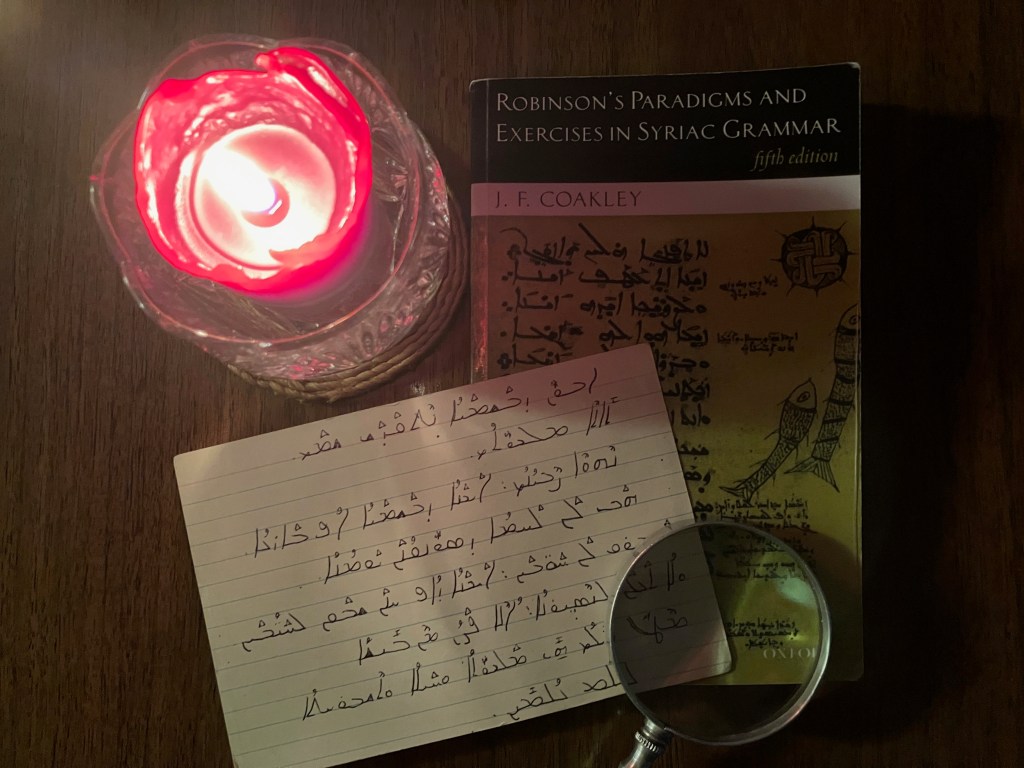
This is what I learned from learning Syriac. Syriac script is consonantal. Vowels are written as tiny marks added around the consonants like some sort of decorative surround. Syriac vowel shapes are varied, and when first I encountered them they seemed to me random squiggles. They were to me literally indecipherable. I consistently floundered in my guesses as to which vowel was which until finally the professor said, Can you not see the letters? She enlarged the pages double-sized so that the squiggles stood out clear to my sight. Only then could I see: each was distinct, had a different shape, stood for a different sound. I had to learn the details writ large before I was able to see them writ small.

I couldn’t see them until I knew them.

We don’t know what we see; we see what we know.

We cannot judge by our own sight until we are taught how to see.

The prophet does not reject sense perception so much as require its right re-ordering, calling us to learn righteousness and equity. Instruction is promised; the Word will flow from Zion [Isa 2:1-5]; calling people to walk God’s holy highway and to sing joy [Isa 35:8-10].

The sprig sprung from Jesse’s line is like the ‘child who has been born for us’ [Isa 9:6] or the ‘servant’ whose tongue is taught [Isa 50:4]. The church reads these as Jesus, who told those who asked to ‘Go and tell what you hear and see’: blind eyes seeing, deaf ears hearing [Matt 11:4-6]. (Jesus’ juxtaposition of sense terms suddenly makes me wonder if he thought by his answer to open the ears and eyes of those who had asked!)

The sprig sprung from Jesse’s line may be read as Jesus. Yet reading Jesus in this text does not exhaust its possibilities. It promises not only ultimate judgment and ultimate restoration, but also proposes a way to wait in the meanwhile. I cannot see and hear and study to save myself. But I can be reminded that my sight and hearing are limited by what I know and re-called to look and listen and study to be in relationship with the world. Copy righteousness and equity over and over until their shapes are fixed in my hand and my eye. Recite fear of the LORD with my lips and mouth. Walk God’s instruction with my feet. Practice sight and hearing and pray sense enlarged with ‘the knowledge of the LORD as the waters cover the sea’ [Isa 11:9].

A New Year

photo (c) Katherine Brown
For thus says the LORD: 
 Sing aloud with gladness for Jacob, 
 and raise shouts for the chief of the nations; 
 proclaim, give praise, and say, 
 “Save, O LORD, your people, 
 the remnant of Israel.” 
 See, I am going to bring them from the land of the north, 
 and gather them from the farthest parts of the earth, 
 among them the blind and the lame, 
 those with child and those in labor, together; 
 a great company, they shall return here.  
 With weeping they shall come, 
 and with consolations I will lead them back, 
 I will let them walk by brooks of water, 
 in a straight path in which they shall not stumble; 
 for I have become a father to Israel, 
 and Ephraim is my firstborn.

Jeremiah 31:7-9, excerpt from 31:7-14; lectionary for Sunday January 3, 2021

When does the new year start?  When the clock counts down to midnight — voices joining the last ten seconds before the ‘ball drops’?  When the explosions of neighborhood fireworks (illegal), have ended, another 15 or 20 minutes past that?  Or does the new year not really begin until after sleep has set its bound around the old year, newness coming not with the clock but with the dawn — however late and low the light appears.  Although even then…. Is morning itself sufficient, or is the first cup of coffee a necessary measure for eyes to open and see the day?  

We’re in January, now.  The ‘new year.’  Yay.

When does the newness begin?  And how?  And when and how do we know it?

‘Sing aloud with gladness,’ says the LORD.  Really?  The exhortation to song seems tone-deaf to the mood of the year, a command difficult to fulfill.  It seems an odd fit for Jeremiah, as well, prophesying as he did so horrifically of judgment and of end.   

‘For thus says the LORD:  Sing aloud with gladness for Jacob, and raise shouts for the chief of the nations; proclaim, give praise, and say ‘Save, O LORD, your people, the remnant of Israel.’ 

Glad songs and shouts of praise and demands for salvation.  

Commentaries and translations note the difficulty in verse 7.  It would make more sense if the songs of gladness were of salvation already realized rather than salvation for which the singers still cry.  Why sing when it’s incomplete?  When the hurt has not been healed, the wounded continue lame, the blind still need leading.  How is it possible to sing gladness and — in the same phrase — demand saving?  How is it possible to sing aloud while weeping, to walk and to plead and to not stumble on the way?  How resolve the contradiction of the proclamation that the LORD will gather Jacob home, that the people will be radiant over God’s goodness, and that the LORD already has ransomed and redeemed, and that we — hearing the words of Jeremiah to whom the word of the LORD came — are called here and now to ‘Sing aloud with gladness … and say ‘Save, O LORD, your people.’

‘Save, O LORD, your people.’

When does the newness begin?

I’m not immune to the idea of New Year’s Eve.  I watch the crowds on TV:  the lights and the energy and the thrum of anticipation that rises as the hour grows near.  I know the falseness of the thought that a critical tick of a clock will suddenly transform the world (Cinderella and her pumpkin coach at midnight notwithstanding) — but even if the the basis is a fictional construct (this particular measurement of time rather than that one), there is something real behind it.  Time does turn.  Night’s dark does give way to day.  Now that we’re past the winter solstice, each day’s light lasts a tiny bit longer than the one that came before.  There is truth in the claim that time turns on into new.  The mistake is not claiming that newness is, nor longing for that newness in our lives.  The mistake is misunderstanding what it is, or imagining it as something we can grasp rather than something we are given, even something that grasps us.

Maybe this is why this passage is set as a text for Christmas.

Birth comes through the world broken open.  

‘Then shall the young women rejoice in the dance, and the young men and the old shall be merry.  I will turn their mourning into joy, I will comfort them, and give them gladness for sorrow. I will give the priests their fill … And my people shall be satisfied with my bounty,’ says the LORD.’ As if newness begins with recognition of what’s been shattered.  As if newness begins with the awareness of mourning and sorrow, of insufficiency and lack.  With the acknowledgement of what we’ve suffered and of what suffering we’ve caused.  With the admission that we cannot save ourselves.

This text does not deny the reality of a broken world, a suffering people, creation groaning.   It’s not all shining delight.  The way is walked by blind and the lame and the laboring.  Supplications shall be raised along with the song.  ‘With weeping they shall come,’ the LORD promises.  Last week I read news stories of those who received the first doses of COVID vaccine and found themselves weeping.  Their tears came as surprise, a belated reaction to all the tears that had been swallowed of necessity, pressed down until it was hard as rock within, there being no space nor energy to spare in the midst of so much suffering.

Weeping signs the pain that could not be allowed until the promise had broken in.  Hope cracks the stone, new-seen as seed.  The seed shows its seam; a hint of green unfurls.

‘Sing aloud with gladness for Jacob, and raise shouts for the chief of the nations; proclaim, give praise, and say, ‘Save, O LORD, your people, the remnant of Israel.’

Newness begins as we cry out for it.  Even while our eyes are still confused by exhaustion and by gloom.  Even before the coffee.  Even before the dawn.  

Newness begins now.  In gladness sung to the one who can save, demanding the salvation that only that one can give.