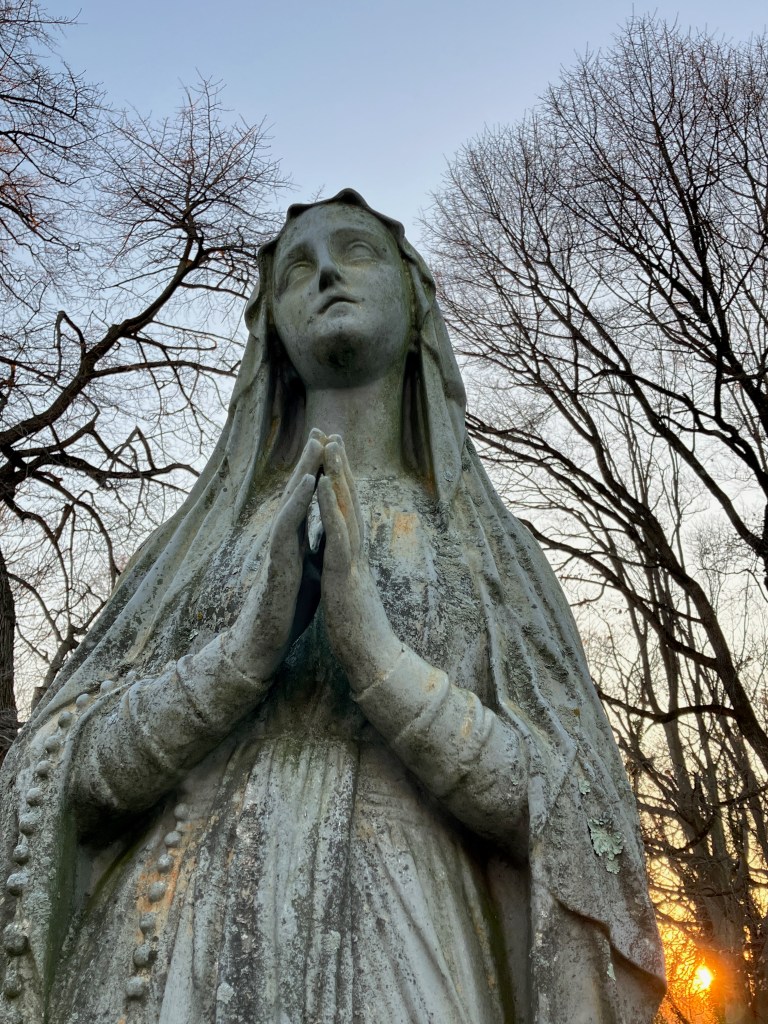
Testimony in the Wilderness

(c) Katherine Brown

“Moses descended Mount Sinai, and the two tablets of the testimony were in Moses’ hand in his descent from the mountain. Moses did not know that the skin of his face shone from his speech with [the LORD].”

Exodus 34:29; See Exodus 34:27-35 NRSVUE

The wind is wild tonight. I sit at my desk upstairs and hear it roar through the trees. Do I hear the creaking of the trees themselves? Does the house shudder slightly as another gust hits it? Something outside crashes loudly down. It’s too dark to see what.

The wind unsettles me. To be fair, I am already unsettled. Too much these weeks do I lurch from news report to news report, calming myself each time with recourse to countering commentary. (Also dark chocolate.) But these means keep me bracketed to meaning as defined by this world. Even opposing empire, I am allowing empire to define the terms of engagement.

With difficulty I wrest my mind from the wind’s violence to Exodus 34: Moses transfigured. I have sat with this text before, focused on the transformative intimacy of Moses and the LORD. Now I feel its larger context of wilderness, of people terrified and mourning and longing to be led into new life, of trauma.

Exodus 34 is a reprise of Moses’ earlier ascent to receive from the LORD stone tablets with the teachings and the commandments (Exodus 24:12-18). Then also Moses had been up there forty days and forty nights. Meanwhile, at the base of the mountain, the people had seen ‘that Moses delayed to come back down’ (Exod 32:1) and responded with the desperate anxiety of an abandoned child. They demanded a god to go before them. Aaron made the Golden Calf, and the people made an unholy festival (Exod 32:2-6), and the LORD made Moses go back down the mountain with the two tablets of testimony, God-carved and God-inscribed. God’s anger had blazed forth, ready to consume, but for Moses standing in the breach (Exod 32:7-14), identifying himself as one of God’s own, not God’s only own. At the end of a dance of judgment and mourning (32:15-33:11), request and response (33:12-23), the LORD said to Moses, ‘Now, carve two tablets of stone like the first, and I will inscribe upon the tablets the words that were on the first tablets which you shattered’ (34:1). A second summons. A second ascent. A second span of forty days, after which Moses descends, shining.

In Exodus 32, the people’s sight of Moses’ absence so consumed them that they rushed to fill it. In Exodus 34, the people see in Moses’ radiance the presence of God.

The text tells that Moses did not know before it tells what Moses did not know. Moses doesn’t need to know his face shines. The people do. They have been oppressed by empire; terrified by wilderness. Maybe they’d imagined, leaving Egypt, that the road to the place God had promised would be straight, that any ascent would be so carefully graded that progress would be steady — that they could walk it without losing pace nor heart. Exodus tells a different story: a series of complaints and protests, of turning and returning. Wilderness life is precarious. God’s people know it so. They need to know it so. We need to know it so. So that they — we — can learn the only presence that will sustain life. Can leave space for it to shine, to speak.

This feels a wilderness time. My surprise at this feeling — or at its pain — is to me convicting. It reveals my mistake in imagining that the journey to kingdom living would be steady. That progress would be stable. Incremental. Within my control. As if control was ever meant to be mine. As if stability, rather than righteousness, is God’s priority. Have I (have we?) imagined myself ‘good people’ and forgotten the call to be ‘God’s people’? Goodness is a shallow cup. God is an inexhaustible well. Terrifyingly deep; ultimately sustaining.

Pray presence at the center. Not the small flickering that speaks of itself, but the great radiance that — even unknowing — tells God. Attend to the light; heed the speech; drink of the source. The stance on any particular issue may be the same; the strength will be greater.

Pray to see, pray to be, God’s testimony even, or especially, in this wilderness.

Learning to Read*

photo by Katherine Brown: BHS open to Genesis 22

The book arrives two days after I order it online. The UPS man drops it off, bangs twice on the door and is already halfway back down the walk when I retrieve the package. I open the box. The book slides out into my hand. It is a small, heavy volume with a red-brown cover: Biblia Hebraica Stuttgartensia. I riffle through pages that still cling to each other. The print is small and squared with tiny flourishes and dots. It looks random, not like letters. It takes faith to believe that these shapes can be read.

The first morning of class, we chant the alphabet through: “alef, bet, gimmel, dalet.” We are all seminarians. We are also social workers, teachers, headhunters, lawyers, associate pastors. We are Baptist, Episcopalian, Methodist, Pentecostal, Presbyterian, Reformed Church of America and United Church of Christ. We are single, married, divorced and widowed. Megan is pregnant; Ann’s husband is in Iraq. We are 11 women and three men gathered for six summer weeks at Wesley Theological Seminary to learn Biblical Hebrew.

I spend the first night murmuring the letters, copying them until my arm aches. The next day we meet the vowels, the tiny dots and dashes generally placed under the letters. We sound out words. We dive into translating texts. I struggle with the shapes and sounds washing over me, unable to imagine them ever resolving into meaning. “Trust me,” the professor insists briskly, “You’ll get it. In two weeks you’ll be reading this page.” I am overwhelmed, as in a wave, swirled head over heels until I’m not sure which way is up, dumped sandy and spitting, eyes streaming, on the shore. And then the next wave is along. No sure footing, no knowing how to swim under and through in this wide sea.

“Why are you studying Hebrew?” my husband asks. Even in this first week I can tell him.  Already we have glimpsed the wonderful and terrifying breadth of the language. The noun that means “words” also means “events” or “actions” — speaking twined with doing. The verb that means “to be” also means “to become” or “to happen.”

We learn to parse verbs. Hebrew verbs carry their own subject an object in the affixes and suffixes attached to the three-letter root.  We learn to peel away the extra letters, to add back the missing, to consider again the whole.

I learn to read with my tongue, as well as my eyes. Sometimes this doing — reading aloud, involving my body as well as my mind — leads me to understand what I think I do not know.

I start to recognize some of the words. The four-letter word that English Bibles translate as “the LORD” is one of the easiest to see. Faced with a new passage I look first for this word; this leaves that many fewer words to translate. Scholars suggest that this Tetragrammaton is derived from the verb root “to be, to become, to happen.” The very name of God, then, encompasses not just static perfection complete and achieved but the causing yet to be, creation yet becoming.

Week after week we take quizzes. Each time my initial response is a flight of panic — the wave curving over me again — how can I tell the meaning of so many Hebrew letters? (No longer do I doubt that they hold meaning, only my own ability to access it.) I limit my focus.  Attentive discipline and wild flights of try-this, and word by slow, abiding word the text emerges from the murk.  I catch echoes of the English I know, but the familiar stories are given new and true force in their unfamiliar guise.

We learn grammatical rule after rule, each of which seems compounded with as many exceptions. (In intermediate Hebrew, we joke, the professor will reveal that there really are no rules.) The patterning is apparent but elusive, as much art as science. Slowly we start to build a sense of what is present and must be peeled away; what is missing and must be added. We are not memorizing the language but we are beginning to internalize it. Not yet swimming, but entered into the rocking water.

The class picks up speed. We are getting through entire chapters — although still, the occasional selection of wrong verb root results in a Mad Libs-type translation. We are giddy, enthusiastic, frustrated, amazed. One by one we dream Hebrew: dancing letters, difficult passages. We design a T-shirt with the legend in Hebrew.

The final exam is three hours of translating a passage we’ve not seen before. When we finish we gather on the hill for a picnic — a half-planned potluck with boiled eggs and falafel, pita and hummus, just-picked tomatoes. We stand in a circle, holding hands, hearing the blessing in Hebrew. Baruch atah Adonai, Eloheinu melech ha-olam. Blessed are You, Lord our God, King of the universe.

I didn’t learn to read Hebrew in six weeks. I learned that I shall be reading this sea for the rest of my life, even knowing I will never understand it all.

*Another throw-back post, in honor of the semester starting next week. This is a slightly revised version of the essay run in The Washington Post as ‘Taking the Plunge into Biblical Hebrew,’ Aug. 30, 2004. Then I was the student. Come next week, I am again the instructor, for the first time online.