(c) Katherine E. Brown
You shall answer, and you shall say, ‘… Now, see: I bring in the first fruit of the ground which you gave to me, LORD.’ You will put it before the LORD your God, and you will bow low before the LORD your God, and you will rejoice in all the good which the LORD your God gave to you and to your house, you and the Levite and the alien who is among you.
Deuteronomy 26:5a, 10-11; see Deut 26:1-11 NRSVUE
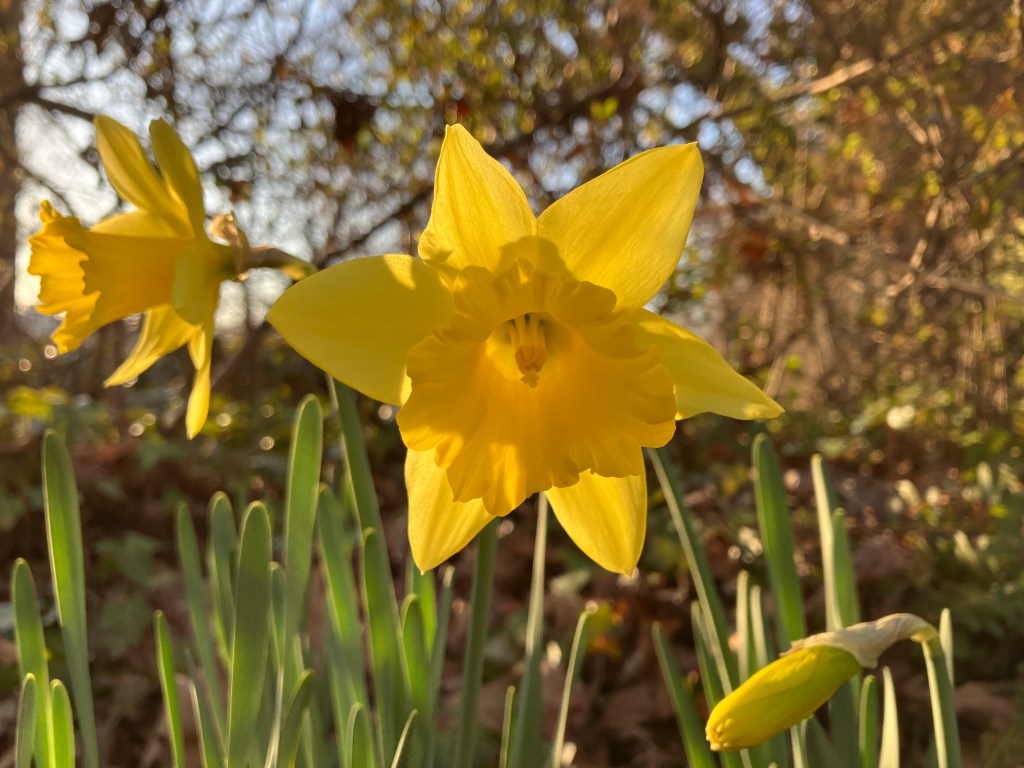
I am extra aware of the light the first week after the clocks spring ahead. It’s not just that my alarm rings earlier, as measured by the sky; it is the strangeness of the afternoon light: clear at an hour when I am expecting its tone to have warmed with the sun’s lowering. The sun keeps its own time still, yet its rhythm, too, is shifting, each day longer by minutes. By the end of January, we can walk in daylight as late as 5:30; as late as 6 by February’s end. Changing the clock does not itself add to the day, but it does make plainer what has been taking place already, making the incremental seem sudden, and more entire. Everything seems to have come on at once. Red buds are visible on the maple tree. Snowdrops’ slender white flowers are now joined by yellow aconite and purple crocus and hellebore in muted colors of cream and mauve. The withies of winter jasmine have grown green and put out yellow flowers. I look out the back window and see daffodils madly daffodil-ing — cups and petals unfolded and shining golden in the sun.
These buds and blooms are the first fruits of spring, somehow made more noticeable by the admittedly artificial, and frankly sometimes-irritating, practice of changing our clocks. Shifting my rhythm this way shifts something in my sight. Spring’s good is sprung. Daffodils dance yellow in the March wind, and their apparent joy insists upon being rejoiced-over.
Deuteronomy’s first-fruits are not the bright blooms of the neighborhood but the first of the season’s harvest on which the people will depend for the rest of that year and until the next year’s harvest is ripe. These first fruits are not to be hoarded nor privately gloated over. These first fruits are to be given back, that the whole harvest may be received as gift.
I appreciate the precision of the liturgy in this text: directions for posture and gesture and scripted speech. The first-person recitation places each one who recites it in continuity with the vulnerable father, the oppressed stranger, the one heard and seen and saved and brought in to a land from which first fruits would grow — these very fruits, brought here in this basket. To practice this liturgy is to be reminded that the ‘exceptionalism’ of God’s people is not inherent in themselves but in God, the giver of all the good.
Read on. The liturgy is larger than the scripted gestures and declarations in front of the altar. The next step in the practice is to ‘rejoice in all the good the LORD your God has given you’ — the very good which the one-who-trusts-flesh cannot even see? Rejoice in all the good along with the portionless priests, with the alien who is among you. Not sharing ‘yours’ with ‘them’ but receiving with them the LORD’s giving to all.
Rejoice! This injunction brackets and punctuates the core of Deuteronomy [see 12:7, 12, 18; 16:11, 14, 15; 26:11]. God’s people are commanded to bring offerings at set times, to eat and to be glad in the presence of the LORD and the company of the vulnerable. Gladness as scheduled practice. Make the feast not for being already glad; become glad in the making of the feast.
Joy may seem an unrealistic demand, even unkind in the context of these days. (How can joy be expected in the face of so many summons to fear?). Then I remember the text context of these commands to joy: the people are yet in the wilderness, that time of turmoil and fear and traumatic becoming. Even so, even then, even here, God’s people are given the command to rejoice. The practice of joy as the distinctive characteristic of God’s people. Joy multiplied in the making of it. Wilderness resisted in delight dancing and insisting on being rejoiced-with.

 Prudent Graces