Speaking Delight

(c) Katherine E. Brown

On account of Zion, I will not be silent.
On account of Jerusalem, I will not be still —
Until as brightness her righteousness goes out,
And her salvation burns as flame.

Isaiah 62:1 (my transl.); see Isaiah 62:1-5 NRSVUE

The lectionary repeats every three years, so I am again looking at this Isaiah text. Again pondering silence and speech, naming and re-naming, brightness and sight. Again wondering if and how there might be any news in this text so old. I’ve written on it already. Why write on it again? Why keep speaking the need to speak? Is anyone even listening, or are we all tired of the same old summons to righteousness, said as if we’ve made no forward motion in the last 70 years?

The lectionary repeats every three years, and sometimes the ancient text and the current calendar seem so in sync that that synchronicity itself speaks. This section from the prophet Isaiah is assigned for Sunday, the eve of Martin Luther King, Jr. Day, this year also the eve of the presidential inauguration. The concurrence of these two observances has its own awkward synchronicity. One looks back at the man who called the nation to ‘Stride Towards Freedom’ — urging us forward towards making real the ideals we ostensibly espouse. The other inducts into office the man who calls for greatness ‘again,’ said with a backward glance, towards some imagined former, now-lost, luster. Each attitude in its way acknowledges that where we are as a people is not where we are meant to be; they hold this conviction in common with each other. So too Isaiah, the prophet who looks back to look forward, modeling the insight that reiteration may be, after all, part of the point.

The oracle that begins in 62:1 is not beginning from scratch, after all. The last section of the prophetic book, Isaiah 56-66, is replete with call-backs to what had come before, renewing and extending God’s promises to God’s people. Not because life had been static since the promises first were proclaimed but because the proclamation had not yet been fully realized: life had lurched forward, and twisted sideways, and shifted again, and still there was more road ahead.

Time it was that God had declared that the time for silence was past — that time had come to to cry out like a warrior, like a woman in labor — that God was birthing something new in and for God’s people, turning ‘darkness into light’ (Isa 42:10-16). The context for those promises was war, exile, inestimable loss. God’s people had cried out their conviction of forsakenness — and God had reassured that the LORD had not forsaken, that God was returning to embrace, that Daughter Zion should again be a rejoicing bride (Isa 49:14-18; 54:6-8).

Fifty or 100 years on, some of those promises had been realized: official exile had ended; deportees had returned to the land of their origin; Jerusalem had been rebuilt. Yet not all returned. The rebuilt city was less than the remembered old. The rough places had not been made all plain nor the crooked straight; God’s glory had not yet shone so universally bright that all flesh rejoiced in seeing it together (Isa 40:3-5).

Creation’s joy may have burst forth at the anticipation of return, but some 70 years on, its song seemed too soon over (Isa 55:12-13). God’s people were divided. They quarreled. They had to be reminded yet again, to keep justice and do righteousness, that God’s salvation was drawing near, that God’s righteousness being revealed (Isa 56:1). The time for silence was long, long past (Isa 42:13-14). The time to cry out is not yet over (Isa 62:1). Words are required again, and still, until righteousness shines bright and salvation flames. God does not cut short God’s bringing-forth any more than a laboring woman stops her labor short of birth. The only way to go is forward. Not because progress has not been made but because it has not yet been fully realized.

Life lurches forward, and twists sideways, and slouches ahead again, and still there is more road ahead. We look back to get our bearings, align ourselves with the marks, and adjust our way. Until God’s promise is realized fully and completely: salvation aflame and righteousness shining bright and all flesh — all — rejoicing in present glory and bridal delight.
Plowing Ahead

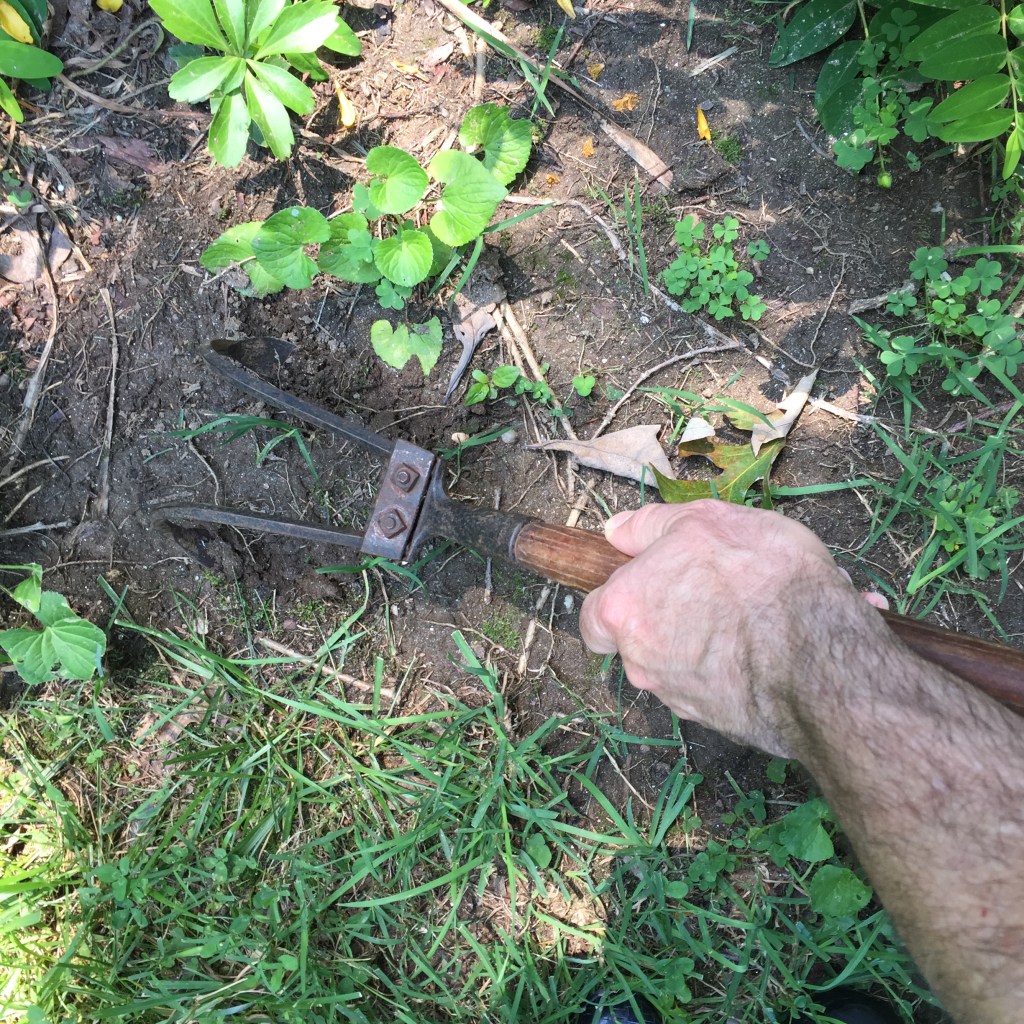
‘A hand to the cultivator’ (we don’t have a plow). (c) Katherine Brown

When the days drew near for him to be taken up, he set his face to go to Jerusalem.

Luke 9:51; excerpt from 9:51-62, lectionary gospel for June 26, 2022

Friday the United States Supreme Court overturned Roe v. Wade. The news was not unexpected. Even so, the decision hit hard. Vulnerabilities hoped historical were re-presenced in language that anticipated further erosion of protections; the rhetoric of power was spun in a way that inverts the reality of its exercise. It all feels too much. News on news on news, all slowly churning into history. And in the face of my enervating discouragement, Luke gives me Jesus’ face, set for Jerusalem.

When the days drew near for Jesus to be taken up’ — that’s what starts this passage: the imminent completion of Jesus’ days. Jesus does not journey of his own inclination but of necessity. It’s an imperative connected to the fulfillment, of his mission.

… he set his face to go to Jerusalem’ — the phrase rings with a flint-firmness of purpose that will not be swayed to the left or to the right, but persists because its end is already known, and its end is new beginning. Luke’s telling has taken a turn. Jesus knows it. He’s the one who’s set his face, turning the story forward. We know it — we’re told it in this verse.

It may not be so clear to those within Luke’s gospel. Even just in Luke 9, the story swings wildly from the disciples’ joys of proclamation [Luke 9:1-6] and healing and feeding [9:10-17], of recognition [9:18-20] and transfiguration [9:28-36] to the shocks of Jesus predicting his passion [9:21-22, 44], a thing they do ‘not understand’ and are ‘afraid to ask’ [9:45]. They argue over which of them is the greatest [9:46-48] and are jealous of others claiming Jesus who do not follow Jesus ‘with’ them — as if their discipleship is the sole measure [9:49-50]. Their story-middle is messy. They may not know what we know: that a new turn in the story has been told. That Jesus has set his face towards his exodus [9:31], his being taken up [9:51], his accomplishment of what he had been sent to do: bring good news to the poor, release to the captives, recovery of sight to the blind, freedom to the oppressed, and declare the year of the Lord’s favor [Luke 4:18-19].

Jesus has set his face to go to Jerusalem. Which doesn’t mean he no longer has time for this world — he teaches and heals, tells parables and utters woes, shares meals with friends and Pharisees and tax-collectors the whole ten-chapter journey. It doesn’t mean Jesus no longer has time for this world. It does mean that Jesus does not forget his goal. That Luke does not let us forget it either, reminding us more than once along the way that Jesus is journeying to Jerusalem.

Samaritans will not receive Jesus because his face is set towards Jerusalem [9:52-53]? Jesus remembers why he has come. James and John might lose sight of the goal, imagining glories of revenge, fire from heaven [9:54]. Jesus’ singleness will not be scattered. He rebukes his disciples; they move on [9:55-56].

Three would-be followers approach — two offer themselves; one is invited. In each interaction, there’s a word of warning, a reminder of what’s at stake. No settled den or nest but an ongoing sojourning [9:57-58]. Kingdom proclamation a work more urgent than the highest of filial responsibilities [9:59-60]. A plow that must be pushed on forward so that the ground may be furrowed to receive the seed [9:61-62].

Jesus’ face is set. His hand is put to the plow. He will not turn back.

There will be opposition. There will be discouragement. There is both of those things.

This middle in which we live feels messy, even scary. We’re not sure where we are in the story. We’ve been mistaken before — and may be again. We’ve had moments when we knew ourselves authorized and empowered, when we went out and did amazing things for God. Fed the hungry; housed the homeless. Wrapped rainbows and hung signs and stood in witness. We’ve exulted in progress and been stunned at its retreat. The journey may be marked by our dates and occasions — 1964 or 1968; 2008 or 2016; 1973 or 2022 — but it is not measured by them, because this is not our story. It is God’s story. We cannot stop it nor turn it back. No one can. Because God has set God’s own face to bring God’s kingdom in.

To sojourn in God’s story, to plow forward along God’s way, means making time for our work in this world, recommitting ourselves to ‘resist evil, injustice, and oppression in whatever forms they present themselves,’ recognize the sacred worth of all, and ‘to seek for every individual opportunities and freedom to love and be loved, to seek and receive justice, and to practice ethical self-determination.’

‘When the days drew near for Jesus to be taken up, he set his face to go to Jerusalem.’

Flint-faced certainty that the kingdom is come near. That’s what resonates. That’s what we’re called to — this singleness of purpose, aiming through all the incidents and accidents of the world towards the world’s full re-creation in liberation and in love.