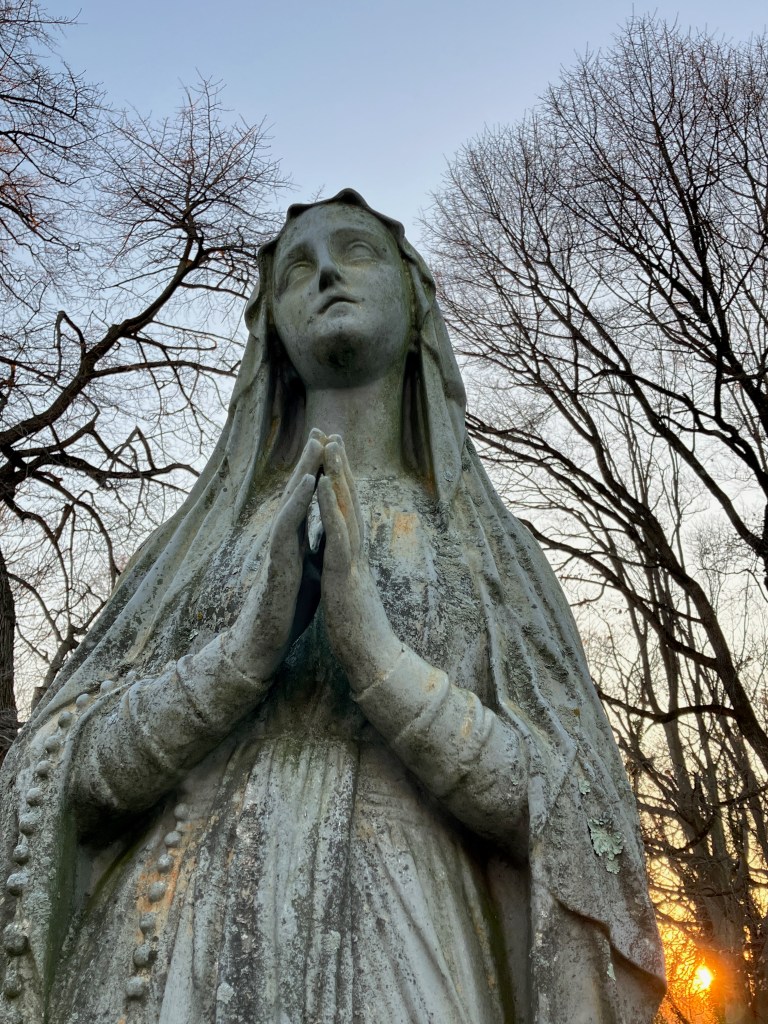
(c) Katherine Brown
“Moses descended Mount Sinai, and the two tablets of the testimony were in Moses’ hand in his descent from the mountain. Moses did not know that the skin of his face shone from his speech with [the LORD].”
Exodus 34:29; See Exodus 34:27-35 NRSVUE
The wind is wild tonight. I sit at my desk upstairs and hear it roar through the trees. Do I hear the creaking of the trees themselves? Does the house shudder slightly as another gust hits it? Something outside crashes loudly down. It’s too dark to see what.
The wind unsettles me. To be fair, I am already unsettled. Too much these weeks do I lurch from news report to news report, calming myself each time with recourse to countering commentary. (Also dark chocolate.) But these means keep me bracketed to meaning as defined by this world. Even opposing empire, I am allowing empire to define the terms of engagement.
With difficulty I wrest my mind from the wind’s violence to Exodus 34: Moses transfigured. I have sat with this text before, focused on the transformative intimacy of Moses and the LORD. Now I feel its larger context of wilderness, of people terrified and mourning and longing to be led into new life, of trauma.
Exodus 34 is a reprise of Moses’ earlier ascent to receive from the LORD stone tablets with the teachings and the commandments (Exodus 24:12-18). Then also Moses had been up there forty days and forty nights. Meanwhile, at the base of the mountain, the people had seen ‘that Moses delayed to come back down’ (Exod 32:1) and responded with the desperate anxiety of an abandoned child. They demanded a god to go before them. Aaron made the Golden Calf, and the people made an unholy festival (Exod 32:2-6), and the LORD made Moses go back down the mountain with the two tablets of testimony, God-carved and God-inscribed. God’s anger had blazed forth, ready to consume, but for Moses standing in the breach (Exod 32:7-14), identifying himself as one of God’s own, not God’s only own. At the end of a dance of judgment and mourning (32:15-33:11), request and response (33:12-23), the LORD said to Moses, ‘Now, carve two tablets of stone like the first, and I will inscribe upon the tablets the words that were on the first tablets which you shattered’ (34:1). A second summons. A second ascent. A second span of forty days, after which Moses descends, shining.
In Exodus 32, the people’s sight of Moses’ absence so consumed them that they rushed to fill it. In Exodus 34, the people see in Moses’ radiance the presence of God.
The text tells that Moses did not know before it tells what Moses did not know. Moses doesn’t need to know his face shines. The people do. They have been oppressed by empire; terrified by wilderness. Maybe they’d imagined, leaving Egypt, that the road to the place God had promised would be straight, that any ascent would be so carefully graded that progress would be steady — that they could walk it without losing pace nor heart. Exodus tells a different story: a series of complaints and protests, of turning and returning. Wilderness life is precarious. God’s people know it so. They need to know it so. We need to know it so. So that they — we — can learn the only presence that will sustain life. Can leave space for it to shine, to speak.
This feels a wilderness time. My surprise at this feeling — or at its pain — is to me convicting. It reveals my mistake in imagining that the journey to kingdom living would be steady. That progress would be stable. Incremental. Within my control. As if control was ever meant to be mine. As if stability, rather than righteousness, is God’s priority. Have I (have we?) imagined myself ‘good people’ and forgotten the call to be ‘God’s people’? Goodness is a shallow cup. God is an inexhaustible well. Terrifyingly deep; ultimately sustaining.
Pray presence at the center. Not the small flickering that speaks of itself, but the great radiance that — even unknowing — tells God. Attend to the light; heed the speech; drink of the source. The stance on any particular issue may be the same; the strength will be greater.
Pray to see, pray to be, God’s testimony even, or especially, in this wilderness.

 Prudent Graces