Turn our return!

(c) Katherine E. Brown

“When the LORD turned again the captivity of Zion, we were like them that dream.”

Psalm 126:1 [KJV; see Psalm 126]

Psalm 126 lives in my mouth in its King James cadences, whether spoken aloud or in my mind’s ear only. The “t’s” in “turned” and “captivity” are clipped in soft staccato while the “e” of “dream” stretches longer than its single syllable. Its sound ebbs as I am drawn into the vision it pronounces. Remember that dreaming? Remember what it was to live a dream?

Pause at the thought of dream, then let the recitation of it tumble from my lips. My mouth pronouncing the phrases is again brimful of brightness. Remember what it was when others saw our joy, named it for us, even before we ourselves recognized that our shoulders were lifting, our steps become lighter? “The LORD has done great things for them.” O! Savor it!

My singing tongue slows, then continues, resolutely: “The LORD has done great things for us, whereof we are glad.” The glow of remembrance fades even as I recollect it. My voice catches, my tone shifts from reverie to plea: “Turn again our captivity, O LORD!…” Memory of God’s prior graces moved into urgent demand of God-self: remember us, do again great things for us.

Psalm 126 is a psalm from a middle place. Prayed by a people who know God has done great things for them. Prayed by a people who know, also, that the great thing is yet unfinished, who pray that God is not done with them.

I pray this psalm as I walk in the day. I pray this psalm as I lie down at night. I pray this psalm as I read the news. I pray this psalm as I move into Holy Week. I will pray this psalm on past this Easter Sunday, as I am praying it now, past all the prior Easters that have been.

“Christ is risen!” we will proclaim on Sunday. The sanctuary will be filled with flowers and the Hallelujah Chorus and jubilation. Our mouths will be filled with laughter and our tongues with shouts of joy.

And then we will leave the sanctuary and go into the world. And then we will find, again, or still, that resurrection has changed everything and that the world remains broken.

The LORD has done great things for us! Turn again our captivity!

The Hebrew is something like ‘Turn, O LORD, our returning ….’ The verb echoed in its object; the dream memory of v.1 revised in v.4 to imperative demand. ‘Turn our return.’ The unfamiliar syllables feel awkward in my mouth. They resonate differently than “turn again our captivity.” The latter might be read as a turning-back, a restoration to what was before. I’ve pictured it so: freed exiles streaming back to a rebuilt city. Perhaps this psalm was rooted in a real memory of return, yet in that history, the city’s rebuilding was but an incomplete fulfillment. God called God’s people to further walking. God’s people called God to further rescue.

Read Psalm 126 not as returning back to some prior way of being but as turning on to what yet will be. The final verses tell it so: they do not rest in the storehouses of some prior season’s harvest but call for sowing anew and promise that the resulting harvest will be abundant, occasion for new shouts of joy. Easter does not turn back the clock nor deny death. Easter overcomes it: Thomas knows the risen Jesus not by his unblemished skin but by his wounds.

The world remains broken. Sow the seed anyway. Because resurrection has changed everything. Because we can practice it. Must practice it. Sing joy — even in tears, even while weeping — that in singing we experience already the harvest anticipated as God turns our return on towards God’s intended end.

Resistance Springing

(c) Katherine E. Brown

You shall answer, and you shall say, ‘… Now, see: I bring in the first fruit of the ground which you gave to me, LORD.’ You will put it before the LORD your God, and you will bow low before the LORD your God, and you will rejoice in all the good which the LORD your God gave to you and to your house, you and the Levite and the alien who is among you.

Deuteronomy 26:5a, 10-11; see Deut 26:1-11 NRSVUE

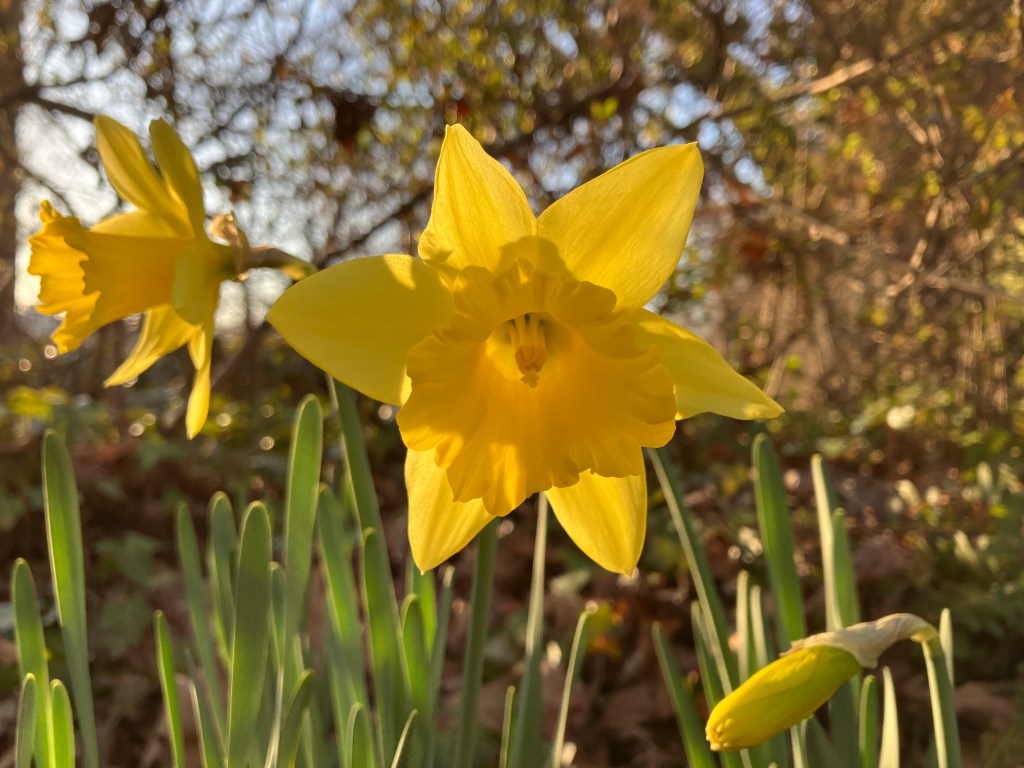
I am extra aware of the light the first week after the clocks spring ahead. It’s not just that my alarm rings earlier, as measured by the sky; it is the strangeness of the afternoon light: clear at an hour when I am expecting its tone to have warmed with the sun’s lowering. The sun keeps its own time still, yet its rhythm, too, is shifting, each day longer by minutes. By the end of January, we can walk in daylight as late as 5:30; as late as 6 by February’s end. Changing the clock does not itself add to the day, but it does make plainer what has been taking place already, making the incremental seem sudden, and more entire. Everything seems to have come on at once. Red buds are visible on the maple tree. Snowdrops’ slender white flowers are now joined by yellow aconite and purple crocus and hellebore in muted colors of cream and mauve. The withies of winter jasmine have grown green and put out yellow flowers. I look out the back window and see daffodils madly daffodil-ing — cups and petals unfolded and shining golden in the sun.

These buds and blooms are the first fruits of spring, somehow made more noticeable by the admittedly artificial, and frankly sometimes-irritating, practice of changing our clocks. Shifting my rhythm this way shifts something in my sight. Spring’s good is sprung. Daffodils dance yellow in the March wind, and their apparent joy insists upon being rejoiced-over.

Deuteronomy’s first-fruits are not the bright blooms of the neighborhood but the first of the season’s harvest on which the people will depend for the rest of that year and until the next year’s harvest is ripe. These first fruits are not to be hoarded nor privately gloated over. These first fruits are to be given back, that the whole harvest may be received as gift.

I appreciate the precision of the liturgy in this text: directions for posture and gesture and scripted speech. The first-person recitation places each one who recites it in continuity with the vulnerable father, the oppressed stranger, the one heard and seen and saved and brought in to a land from which first fruits would grow — these very fruits, brought here in this basket. To practice this liturgy is to be reminded that the ‘exceptionalism’ of God’s people is not inherent in themselves but in God, the giver of all the good.

Read on. The liturgy is larger than the scripted gestures and declarations in front of the altar. The next step in the practice is to ‘rejoice in all the good the LORD your God has given you’ — the very good which the one-who-trusts-flesh cannot even see? Rejoice in all the good along with the portionless priests, with the alien who is among you. Not sharing ‘yours’ with ‘them’ but receiving with them the LORD’s giving to all.

Rejoice! This injunction brackets and punctuates the core of Deuteronomy [see 12:7, 12, 18; 16:11, 14, 15; 26:11]. God’s people are commanded to bring offerings at set times, to eat and to be glad in the presence of the LORD and the company of the vulnerable. Gladness as scheduled practice. Make the feast not for being already glad; become glad in the making of the feast.

Joy may seem an unrealistic demand, even unkind in the context of these days. (How can joy be expected in the face of so many summons to fear?). Then I remember the text context of these commands to joy: the people are yet in the wilderness, that time of turmoil and fear and traumatic becoming. Even so, even then, even here, God’s people are given the command to rejoice. The practice of joy as the distinctive characteristic of God’s people. Joy multiplied in the making of it. Wilderness resisted in delight dancing and insisting on being rejoiced-with.

Surprised by Joy

Winter Camellias. Photo (c) Katherine E. Brown

“And seeing the star, they rejoiced with very great joy. And going into the house, they saw the child with Mary his mother and, falling down, they worshipped him, and opening their treasuries, they offered him gifts: gold and frankincense and myrrh.

Matthew 2:10-11 (from Matthew 2:1-12, NRSVUE linked here)

The Twelve Days of Christmas are past. Now we’re at Epiphany. Three Kings Day. January 6.

Does that last calendar-date caption sound now more political than liturgical? Maybe recent history reminds us that the text has been political since it was written. The first reported human speech in Matthew’s gospel is, after all, the query uttered by the magi, “Where is the one born king of the Jews?” Don’t adorn their question with the fairy-tale garb of tradition — opulent robes and jewel-studded crowns, imagined camels and an expansive retinue. That keeps the figures safely constrained in ancient story. Suitable for nativity plays (children wearing borrowed bathrobes and crowns of foil-covered cardboard). Nothing to do with our lives once the season’s church services are past. Nothing to do with reality.

Reread that query. Words said by humans, not angels. Words uttered in a real place, at a real time, to a real king — Herod, insecurely power-hungry given the larger real-world context of Imperial Rome in oversight of all his machinations. A query about a king that disturbs a king so greatly that all Jerusalem is disturbed with him. Does the idea of a power-hungry leader and a power-roiled city sound real enough?

Reread the magi, too. Not as kings with retinues but as analysts with responsibilities. In DC terms, maybe, career civil service. Matthew’s magi are not Luke’s shepherds, who were minding their own business out there in the fields until suddenly that choir of tinsel-haloed cherubs appeared in the church balcony. Matthew’s magi have a different role, a different work. They read the visible signs of change in the world; they follow where those signs lead. They observe. They inquire. They discern by what has risen new (that star) and by what is old (the prophets’ writings). They ask questions, including of traditions and cultures not their own. They engage in conversations, even conversations at cross-purposes (“Go and search diligently for the child,” Herod tells the magi as if he too desires to worship) — which to me is perhaps the realest part of this story’s reality: the intersection and opposition of desires both holy and horrific. Which intersection and opposition — accurate information and duplicitous intent — yet conspire to lead the magi towards their journeys’ end.

Herod sends the magi to Bethlehem. And as they go, they see again the star whose rising they had seen before. The star going ahead of them until it stood above where the child was.

“Seeing the star, they rejoiced with very great joy.”

Joy before they entered the house. Joy before they saw the child with Mary his mother. Joy before they knelt and worshipped and opened their treasury to offer him gifts. Joy maybe because the star they’d lost sight of for a while (else why would they have showed up in Jerusalem?) was again bright before their eyes. Leading them. Delighting them. Opening them for encounter anew.

Maybe the reason to return to this story year after year is not just to be reminded of its reality but to be recalled by it to the reality that undergirds and overarches our own story. Not absolving us of the responsibility to observe, to inquire, to set out as steadfastly and to journey as diligently as we can. But recalling us to the the star’s reappearing. Reminding us that our purpose is not power but worship. We may pause in power’s halls (the magi speak to Herod with equanimity, secure in their expertise, unafraid to ask) but it is the star’s promise that draws us on, that guides us to our true end: the encounter that drops us to our knees, curves our mouths into smiling Os of awe, opens the treasure of our hearts that we may give.

Joy is the pivot on which the magi’s journey turns, the twist that sends them journeying again. Traveling another way. Returning to where they had been even if they were not who they had been when they left, re-shaped as they were by their journey in surprising, delighting joy.

May I be re-shaped by their story to journey truly in my own.

Sunday Morning Balcony Prayers

photograph (c) Katherine Brown*

Sunday mornings when I can, when there is time between staff’s pre-worship meeting and worship itself, when there is no class to teach or other meeting between, I go up to the balcony and I sit in the highest, farthest-back pew, and I look out past the rows in front of me, and the balcony rail, over the sanctuary below, and I pray.

Sometimes my prayers are worded. A list of names, of needs, of thanks. A petition that there will indeed be worship in this place, and that I may know it. Sometimes my prayers are wordless. A deliberate setting aside, an attempt at stilling myself, to this particular present, this particular place. The cream-white walls of the sanctuary; the shallow curve of the ceiling; the stained glass in the far front wall.

Sunday morning balcony prayers.

In the chancel below, the choir rehearses to piano accompaniment. The head usher refills the oil in the tall candlesticks set on the altar. Someone else maneuvers a long pole to open the high-up shutters on slender side windows. Now the sanctuary is less shadowy, more light. In the balcony, the AV team opens the console and begins setting up.

I am in the highest, farthest-back balcony pew, slightly apart from all the preparation that continues apace, looking for stillness in the pen on the page. The piano drops out and I pause my pen to listen. The choir sings, ‘Here I am to bow down. Here I am to worship.’ Hear the harmony, giving the melody line richness and depth. Think of all the parts that move, the parts in which we move. Move towards one another, towards that which is other entirely.

I sit and I listen and look straight ahead. The far wall seems to recede as I stare at it, growing slightly smaller and more distant … and the space between, the sanctuary itself, grows bigger, as if it could hold the world. As if it does.

I think of other spaces, other sanctuaries. Flying my bike down the hill and along the nearby line park. The trail curving with the creek and between the trees which stretch so tall, their green canopy a sanctuary ceiling above. Joy in this flight, this path, this place. The amber-watered creek. The marshaled trees. The blue sky. Others also ride and walk; they push strollers and hold leashes, and their presence is part of my gladness. Crows caw roughly and robins chirrup frantically and that loud, clear-water warble is the song of the tiny wren. We are all here; here is all of ours. Life not as possession but as participation, membership, movement.

Back to the balcony. No seraphim-sung Holy, Holy, Holy (Revelation 4:8). People’s voices, here on earth; human bodies moving. Choir now rehearsed. A choir member waves to me (I am apart but not invisible!). The AV team runs mic check. All of these strands being gathered together. Woven into worship. Here. In other churches, other places. None of this mine. All of this ours as we are invited in. Members in the movement and the music.

Lay my pen down. Close the book and fold my hands in my lap and be. Be spun. To be woven again into the whole.

*I waited to take the picture until the path was clear of walkers, bicycles, and chipmunks.

Breakfast on the beach

photograph (c) Katherine Brown

Just after daybreak, Jesus stood on the beach, but the disciples did not know that it was Jesus. Jesus said to them, “Children, you have no fish, have you?” They answered him, “No.” He said to them, “Cast the net to the right side of the boat, and you will find some.” So they cast it, and now they were not able to haul it in because there were so many fish. That disciple whom Jesus loved said to Peter, “It is the Lord!”

John 21:4-7a [from John 21, NRSVUE]

A week of Vacation Bible School, our first after long while. Thirty children, a dozen youth helpers, and another dozen adults. Decorated spaces and energetic music and four stories about the way God feeds God’s people. With manna. With endless enough. With vegetables and water. With bread and fish.

Me, I don’t anticipate VBS with unmitigated enthusiasm. The cartoon puppets and pop music and bright-T-shirts-for-volunteers are not my style. (I come home after, button on a cotton shirtdress, and feel myself again.) There are compensating charms, however: the children’s energy as they sing and move; the one whose pipe cleaner creation is a ‘funny squiggle dancing thing!’ and whose goodbye pat is soft on my back; discussion about how to be a friend, about feeding the whole world.

Mostly I love the stories. I love telling them, acting them, helping the children learn the words with their bodies as well as their minds. I love the moments when a spark seems to catch. We act out the story of Elijah and the widow, letting every child have a turn: each time a child-widow hands a last-cake to a child-Elijah, I slip another plastic cake out of my pocket and onto the ‘widow’’s plate. ‘Let’s do it again!’ the children clamor, and we do. One sunny face looks up and laughs: ’You’re being God making more cakes!’ She is delighted at her recognition of the story in the action; so am I.

I awake the last morning of VBS and feel as if I’ve been dreaming John 21, this text telling Vacation Bible School. I nearly laugh aloud with the recognition of the story in the week.

Breakfast on the beach.

John has already told Easter: Jesus appeared to Mary Magdalene in the morning [20:11-18], and to the disciples that same evening [20:19-23], and to Thomas, too, a week later [20:24-29]. Resurrection has been experienced in the text, and resurrection has been written so that others may know it too [20:30-31]. So. Resurrection. What next?

John seems to take a breath to start on this next movement of the story: ‘After these things…’ He tells us what the disciples don’t yet know. Jesus will show himself again, and ‘in this way’ [21:1]. The disciples have been out on the sea all night, fishing without catching [21:3]. This is told in one terse verse, yet the action stretched over hours and involved much effort. Get the boat out to sea — push it from the shore until it floats, row out farther, hoist the sail to go to deeper water, then repeatedly throw and haul nets that are heavy even when empty. (Organize volunteers and decorate church spaces and plan a schedule and prepare snacks.) Dawn breaks, and in the half-light of early morning, the disciples realize they’ve drifted back in; they see the shore and a man on it. He calls to them, and they answer, admit the result of all their effort. No fish. Throw your net on the other side, the man says, and they do, and then the net is so full of giant fish that they cannot even haul it in.

Only then do they realize what we already know. The disciple Jesus loved is the first to voice his recognition: ‘It is the Lord!’ Peter, hearing, throws himself toward shore. The others come after. Jesus is there. A charcoal fire is burning; breakfast is prepared. ‘Bring the fish you just caught,’ Jesus urges, and they haul in the fish-laden net, and it does not break — this itself worth noting.

‘Come and have breakfast,’ Jesus summons [21:12]. They do.

See them there on the shore as the sun rises and lays a path of light on the surface of the water. The air is scented with the sharpness of morning, the tang of charcoal smoke, the smell of fish roasting and bread baking on a hot rock. The sun rises higher, dazzles in its brightness; the sky turns hard blue, the day grows hot. The disciples do not ask who Jesus is because they do not need to. Their feeling of unreasoning joy confirms what the beloved disciple had said to Peter. Their awareness quivers brim-ful, on the cusp of overflowing. Presence, Jesus had promised. Abiding, fruit-bearing, joy [15:4-11]. Now it is.

The disciples went out for fish. Knowing themselves sent [20:21], even if they weren’t yet sure to whom or for what, they went. Maybe they hoped to encounter again their Lord; maybe they hoped only to be found faithful to his sending. They know resurrection is real. They may not be sure of what comes next, but they move forward as if towards it. Their movement towards the next-thing draws the next-thing in. The long night of fruitless fishing is not fruitless. Day breaks and joy stands on the shore and calls to them even when they do not realize it is he. Awareness is retrospective — It is joy who has called to us! — then, eyes opened, they are able to remain for a time eating and drinking the awareness that God is present to them and they are present to God. On that dazzling bright morning, breaking fast after a long night, muscles aching with prior effort and present rest, realizing again as if for the first time, that resurrection does not end the story but begins it.

And God makes more cakes for us to share.

Let’s do it again!

The thing with feathers …*

photograph (c) Katherine Brown

Now he was teaching in one of the synagogues on the Sabbath. And just then there appeared a woman with a spirit that had crippled her for eighteen years. She was bent over and was quite unable to stand up straight. When Jesus saw her, he called her over and said, “Woman, you are set free from your ailment.” When he laid his hands on her, immediately she stood up straight and began praising God.

Luke 13:10-13, excerpt from Luke 13:10-17, NRSVUE, lectionary gospel for Aug. 21, 2022

‘Bound for eighteen long years,’ he said (Luke 13:16). She heard, and she paused in her praise. Had really been so long. From when would she count it? From when her body’s bearing had become fixed contortion? Or had the binding begun farther back, when the first spider-thread of unease ensnared her? She had dismissed the twinge, whenever it was. Told herself the day’s load had been too heavy, she’d twisted something trying to keep up. But she kept twisting herself trying to accommodate each next sure-to-pass-soon circumstance. Not denying the ache, exactly, but ignoring it. And each day she kept going, that day’s thread twisted together with its fellow until she’d found herself bound by a sticky, wrist-thick rope that kept her hunched in the world, bent over by the spirit’s weight.

When had she last stood straight before this day? The crowd rejoiced at the wonder they had seen. And she in the midst of their sounding joy, was suddenly cast back in her memory.

A goldfinch had caught her eye, and she’d turned her head to follow its flight into the thicket. She’d lost sight of it then. Stood herself still and peered closely until she glimpsed its lemon yellow deep within the tangled branches. A smile had spread wide across her face. She’d had to share the wonder. ‘See!’ she pointed out to passersby. ‘See! A finch, right there!’ Two had paused their own progress and followed her pointing finger with their own eyes. They did not see. She watched their expressions turn from expectancy to puzzlement, then a slight withdrawal towards doubt. ‘See! There!’ she repeated, as if words alone could make it visible. Her insistence kept them there a beat longer, but neither her words nor her pointing finger made them see. The bird was too well hidden to be noticed if you hadn’t already known where it was. Then the goldfinch moved, and its motion made it visible. ‘Oh!’ they all exclaimed together as it flew up from the bush. Another finch flew too, two small brightnesses flitting around each other, darting through the air. ‘Look!’ they exclaimed, “See!’ The sound of their delight drew another from the doorway to see its reason, and so it spread.

How long since she had seen a flying brightness that made her smile? She had walked hunched in the world, bent over by the spirit’s weight, her gaze on her own feet moving along the dusty road. She hadn’t thought of birds. But maybe a tiny thing with feathers had been set within her own soul, too hidden to be noticed unless you knew it there, yet in its own subtle way resisting the rope that had bound her so firmly, working to unwind even one cobweb thread. For she had come here this Sabbath, as she had before, treading the path worn by others’ feet before ever her own had started their journey of persistence.

She had not come asking or expecting birds. She had come in fidelity to the unsuspected feathered thing hidden in the thicket of her own self. The insistence of habit had drawn her there without her knowing why. Then hope had flown and shown itself. Had seen and called her over, pronounced her free and laid hands on her. It had felt as if one hand pulled on her shoulder and one hand pressed the small of her back and together the hands reshaped and stood her straight who had not stood straight for eighteen long years.

She stood now in the midst of the crowd’s sounding joy. Wonder was among them — a bird darting up from the constriction of cares quotidian and extraordinary, delighting with its brightness and its airy flight, delighting even she herself who was its sign, re-awakening her to its presence and its power. A smile spread wide across her face. She had been waked again to demand. ‘See!’ she said, ‘See!’ She had been waked again to the promise that there is something to demand.

Demand the vision. Demand the movement that makes visible hope and joy and life — on the Lord’s day and every day.

* First line from Emily Dickinson

Recognizing Joy*

Boats anchored near St. Michael’s, 2017; photo by Katherine Brown

The bliss of boating is how quickly you are very far away and how connected you are to everything around.  We have shipped not only our lines but, for a time, our workaday world.  We are sailing across the Chesapeake in a 30-foot Cape Dory, chartered out of Annapolis, now sailing to St. Michaels.

It is a chilly day, drizzly and dim.  Paul has on his oilskins; the girls and I are in slickers.  Elizabeth is three, a gallant, gay sailor-girl in a bright orange life-vest, a too-big green slicker, a purple hat and bright blue rubber boots. Her braids curl with the damp.  She leans over to watch the waves and hums happily to herself.  ‘The water is like Play-Doh,’ she says. ‘It has fingerprints in it.’  Margaret is four-and-a-half months, a snug bundle tucked on the floor of the cockpit.  Her little face is framed with the hoods of two jackets; her hands are inside her sleeves. She waves her arms for a while and smiles at us, then slips off into sleep, in a small boat on a wide water.

We arrive in St. Michaels before dusk and anchor in Fogg Cove.  The maritime museum and its Hooper Strait Lighthouse are behind us.  The velvet green lawn of the Inn at Perry Cabin is before us.  We’ve been in St. Michaels before; we’ve looked at this water from those shores.  But now we are seeing the land from the Bay.  It’s an unfamiliar view of a familiar place, and we relish the unexpected charm of the known made strange before turning to chores — changing damp socks for dry ones, heating chili for supper.  We hear the chime of church bells and a clock striking and the honking of geese overhead.  The two girls are in the V-berth; Paul has cribbed it in so neither can fall out.  Elizabeth coos, ‘Go to sleep, Margaret.’ Soon we hear them snoring, and we look at each other and smile.  Paul checks the anchor light. ‘Katherine, come.’  In the dark, a swan is swimming by.

Annapolis to St. Michaels, St. Michaels to Rock Hall, Rock Hall back across the Bay.  A wonderful run:  the wind steady and strong, we on a beam reach.  The main is up, and the jib, and the only sounds are the creaking of the lines, the squeaking of the wheel, and the slap of the waves against the hull.  The sky is blue but cluttered with clouds.  We sail past the Baltimore Light.  We sail into the Magothy and past Gibson Island and past Dobbins Island.  The light is growing quiet by the time we put the engine on; pale, green beams shine through the clouds onto the shore.  We motor on in search of an anchorage, sliding around a curve and into a quiet secluded little cove.  A wooded shoreline, the trees touched with russet, just starting to turn.  A few houses, with docks and boats.  No one out but us.

Our last night aboard.  We have beef stew and the last of a cheap bottle of wine.  The light grows clearer and more golden.  Clouds lit in peaceful glory.  We take mugs of milky coffee back on deck and watch the fading of the light.  The water very still, reflecting the pink and blue of the sky.  The highest clouds are lit coral-pink by the sun, the lower clouds purple-grey.  We see a great blue heron, here a screech owl, listen to the fish splash and see the ripples they make, circles that catch the light.  Margaret dozes in Paul’s arms.  Elizabeth leans into my knee and sighs and says, ‘This is very nice.’

The morning is pearly:  cloudy at dawn, then clearing slightly for the sun, mist rising off glassy water.  Elizabeth climbs into the still damp cockpit.  ‘Elizabeth!’ we call. ‘Come back down — it’s still wet out there!’  ‘I’m looking at the world,’ she tells us matter-of-factly.  ‘It is very beautiful.  Did you know God made the world?’  Paul and I look at each other, then turn to see the world with Elizabeth.

We bundle the girls again into sweaters and life vests and hats.  Margaret is in a jolly mood.  Elizabeth is happy winding a short bit of line around a winch.  We leave a curve of tiny bubbles as we motor slowly out of the cove and into the broader river.  The world here is all pearl.  The light is a suffused, pale, creamy grey.  The water is gently rippled glass, carrying in it the shapes and colors of the clouds above.  Water and sky match, endless and shining.  And in this spell-world, our small boat is caught between gleaming oyster sea and cloudy oyster sky.  We are connected to familiar things in unfamiliar ways, and recognizing joy.

* Another old essay revisited; this an edited version of ‘Recognizing Joy’; originally in Chesapeake Bay Magazine, April 2000.

God’s Planting

Let me sing for my beloved my love-song concerning his vineyard:

My beloved had a vineyard on a very fertile hill. 

He dug it and cleared it of stones, and planted it with choice vines;

he built a watchtower in the midst of it, and hewed out a wine vat in it;

he expected it to yield grapes, but it yielded wild grapes.

Isa 5:1-2; full passage, Isa 5:1-7, for Aug. 18, 2019 linked at https://www.biblegateway.com/passage/?search=Isaiah+5%3A1-7&version=NRSV

It feels a bit awkward trying to appropriate for my own life texts so obviously addressed to a community.  The prophet speaks of and to ‘the house of Israel’ and ‘the people of Judah’ (5:7) — the nation planted for justice and righteousness (Isa 5:7), yet yielding only ‘wild grapes’ (Isa 5:2), ‘bloodshed’ and ‘a cry’ (Isa 5:7).  I can read the text and recall the sound-play that in Hebrew joins and opposes ‘justice’ and ‘bloodshed,’ ‘righteousness’ and ‘a cry.’   I can review the context of eighth century Judah, the inequity of its affluence, the iniquity of its structures, and I can posit convicting connections to my own context. But that reading alone does not carry me through.  I do not need to read the text to see my own world.  I know it already as broken and ill.  Reading the text as a lens on my context — find the parallels, connect the dots — is important and necessary work. Yet doing just this week after week feels reductionist, redundant.  It becomes a short cut that takes me quickly to a blank wall, a dead end.  I stand there staring at graffitied bricks.  There’s no way forward.

But what if I turn the lens the other way?  Instead of treating the text as God’s revelation meant to show me my world and myself, receive the text as a revelation of God’s self.  Read the text and look for God.  What then do I see?  Who is the LORD revealed in this given word?

God as lover.  The singer, the LORD, and the vineyard are conjoined in this title, not just ‘beloved’ but ‘my beloved’ — relationship claimed.

God as gardener.  There’s love in that image as well, and a suggestion of physical exertion and intimate contact.  God breaks up and turns over the soil — heavy, sweaty, dirty work.  God hauls out the stones, sets them aside for the watchtower to be built.  God plants choice vines:  soaks the roots, digs holes and sets the tender plants in, bends to press the dirt around, stakes the tiny vines.  Does God’s back ache?  Are God’s fingers filthy?  Does God pause to wipe sweat from the divine forehead with a forearm?  Does God gaze with pardonable pride at the work, seeing already and gloating with joy over the sure growth coming?  God builds a watchtower and hews out a wine vat and looks forward to the harvest, the processing, the wine given to ‘gladden the heart’ (Psa 104:15), mixed and poured and set on a table for all to partake (Prov 9:1-6).

God as generous, as ultimately invested.  Having given all that could possibly be given:  ‘What more was there to do for my vineyard that I have not done in it?’ (Isa 5:4).  God as hurt and puzzled:  ‘Why did it yield wild grapes?’ (Isa 5:4).  God allowing that emotion, acknowledging the cost of the investment in naming the disappointment of its failure.

God as inviting the vineyard to be invested as well.  The inhabitants of Jerusalem and people of Judah are called to judge between the LORD and the vineyard (Isa 5:3).  Such judgment is only possible when both sides are fully seen.  To ‘judge between’ means to see the vineyard truly, which the text defines as seeing the vineyard in relation to God. So, and again: read the text to see God.   The glance turning back and forth between, from one to the other; looking deliberately, carefully; widening the gaze; acknowledging the identity-with as well as the vast distance between.  

The LORD planted a vineyard.  I — we — are the LORD’s ‘pleasant planting’ (Isa 5:7).  

Harvest will come.  The LORD makes that plain.  God’s plan may be resisted but will not be gainsaid.  God commands creation itself to further God’s aim (Isa 5:6).  Harvest will come.  Yet God wants all of this — planting and nurture and growth and harvest — not done to us but with us.  God calls the vineyard itself to ‘judge between,’ and so that we can see enough to judge, God lights the way with words that shine to reveal God’s self. 

The writing is no graffitied dead-end but an open door.  Through it I glimpse the gardener — if only from behind — bent over and working to till and plant and nurture the growth.   Persistently willing a tableful of joy.

Please, LORD:  Let me see the world with your sight, by your light.  Give me enough heart and courage to walk out into it bearing your image.  Lover, gardener, risking the gift, persistently working to bring the harvest to full and joyful fruit.  As I myself am brought.

Re-minded to Joy

When the day of Pentecost had come, they were all together in one place. And suddenly from heaven there came a sound like the rush of a violent wind, and it filled the entire house where they were sitting. Divided tongues, as of fire, appeared among them, and a tongue rested on each of them. All of them were filled with the Holy Spirit and began to speak in other languages, as the Spirit gave them ability. Now there were devout Jews from every nation under heaven living in Jerusalem. And at this sound the crowd gathered and was bewildered, because each one heard them speaking in the native language of each.  Amazed and astonished, they asked, “Are not all these who are speaking Galileans? And how is it that we hear, each of us, in our own native language? … in our own languages we hear them speaking about God’s deeds of power.” All were amazed and perplexed, saying to one another, “What does this mean?”  But others sneered and said, “They are filled with new wine.” 

Acts 2:1-18, 11-13; text for Pentecost, June 9, 2019

Our house backs up to an elementary school playground.  The children file out for recess and stand in line until dismissed to play.  Immediately, then, they run and shriek.  When I am home on a school day, I am amazed at the volume of the sound and the violence of its coming.   There was a set of schoolchildren in tidy rows.  Now — suddenly — there is a chaotic dispersion, pounding across the pavement, scrambling up the climbing equipment, skirmishing for balls.  As I watch, some order emerges — whether the emergence is in their play or my observation, I do not know.  There is one game over here, and another over there, and these few children squatted on their haunches at the edge of the pavement are probably poking at the hole in the blacktop that has been expanded over several school years’ worth of recesses.  The expenditure of energy and the intensity of focus touch my heart.

I watch the children and wonder.  When was the last time I effervesced in such a manner?  

A few times in college, my friend and I went onto the green after dark.  We ran and laughed and collapsed on the grass and all without benefit of alcohol.  Who needs beer, we scoffed, when there is play.  There was something intoxicating about abandoning the appearance of sense, making ourselves ridiculous for joy.  A delight I feel still when singing aloud as I walk through the city.  Tipping back my head and throwing my arms wide as if to embrace the wind on a gusty day.  Grinning with excitement, and rising to tip-toes on the Metro platform when a train rumbles past and blows its horn.  (I do not entirely forget myself, I admit; I do not wave at the train driver, tempted though I am.)

Why am I thinking about play, about being so intensely present as to risk ridiculousness?  As if this text is about intoxication.  Drunkenness is the claim is raised by those who don’t understand, who sneer at what they hear as noise.  Peter rebuts the charge.  Yet Peter’s rebuttal does not entirely dismiss the issue.  Peter does not argue that the scoffers have mischaracterized the behavior but asserts that they have misunderstood its source.

This is not new wine imbibed, Peter asserts.  This is God’s Spirit ‘poured out’ (Acts 2:14-17).  Listen to what is being said and shouted and sung.  Hear the order that emerges.  This seemingly frantic babble, heard and understood in so many tongues, is all about God.  It is praise for the Lord whose ‘word is very near … in your mouth and in your heart’ (Deut 30:14).  It is wonder that they have lived into God’s promised days of visions and dreams (Joel 2:28; Acts 2:17).  This is not passing gladness.  This is rock-founded.  This is not new wine.  This is joy in the Lord.

Reading Pentecost I wonder.  When was the last time I was that aware of joy?  

Joy as effervescence, burbling forth forth like a spring, foaming over rocks as it tumbles out and down.  Joy welling up as if I am a cup, brimful — I hold a moment quivering still, amazed at its presence, living water in me, joy’s meniscus curved slightly above the edge of my lip — and then I cannot but grin, cannot but wonder, cannot but tell.  Did you see?  Did you hear?  Did you feel?

The Spirit’s spark that Pentecost was not stubborn resolve or impassioned argument or faithful duty.  The Spirit’s spark was joy.  The people flared bright with it, spoke flames with it.  The Spirit lit a fire whose dancing tongues amazed and perplexed and confounded and transformed.

I watch the children.  I read the text.  I need to be reminded of joy.  I need to be re-minded to joy.  Wait and watch, sticks and kindling dutifully arranged in expectation of the spark.  Realize, then, that the tinder is already aglow.  I don’t need to wait for some coming but to see what has already come.  Blow gently and increase the flame.   Sustain it; be sustained by it.  Dip my bucket into the well, trusting to draw it forth brimful and shining. Drink deeply and find myself intoxicated with its urgency.  Catch someone else’s eye.  Grin and gesture to the very well I drew from, look to see joy spark across.

Make myself ridiculous in the expectation.  Make myself ridiculous in the experience.

That’s how it began.  That is how it begins again.

Risk joy.  Pray for it.  Prophesy it.  Live it.  Tell it.