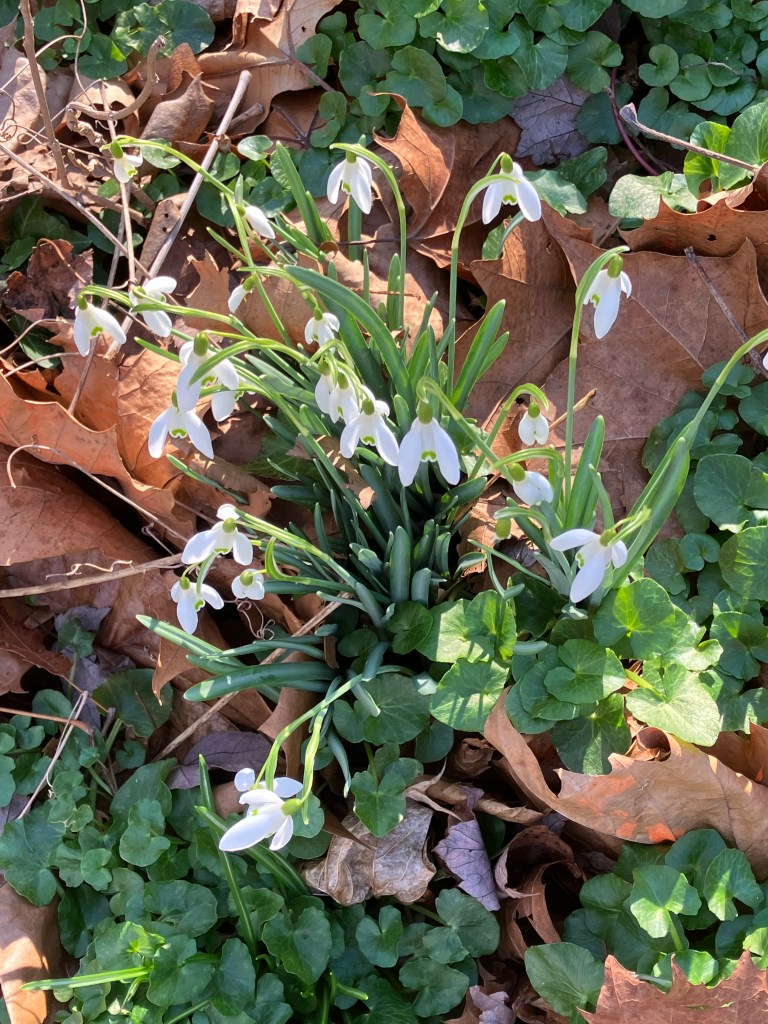
‘Come and see’

photograph (c) Katherine Brown

Jesus ‘said, “Where have you laid him?” They said to him, “Lord, come and see.”’

John 11:34 [from John 11:1-53 NRSVUE]

Sitting in the chapel for our mid-week Evensong. Listening to the lector read John 11. Hearing the familiar story of Martha and Mary and Lazarus, all of whom ‘Jesus loved.’ Lazarus is sick, and the sisters send word, yet Jesus dallies two more days (11:1-6), in which time Lazarus dies (11:13-15). Only then does Jesus go, to be greeted by Martha and by Mary. Each sister in turn asserts that had Jesus arrived more quickly, their brother would be alive (11:21, 32). ‘Yet even now …’ Martha adds (11:22).

‘Where have you laid him?’ Jesus asks; they say, ‘Lord, come and see’ (11:34).

Come and see.

The phrase read aloud catches me unexpected. In the midst of so many familiar phrases, this one leaps out suddenly, surprisingly, clear as a bell.

‘Come and see…’

It’s the invitation Jesus makes at the beginning of John. Two would-be disciples ask Jesus where he is staying. ‘Come and see,’ Jesus replies (1:38-39). ‘Come and see,’ Philip invites skeptical Nathaniel (1:45-46). ‘I saw you,’ Jesus tells Nathaniel, and hearing this, Nathaniel sees who Jesus is; ‘You will see greater things than these.…’ Jesus says (1:47-51).

Come and see. This is the phrasing, the invitation, made at the start of Jesus’ public ministry, before even the ‘first of his signs, at Cana in Galilee’ (2:11). Come and see, Jesus invites followers. Come and see, one follower invites the next. ‘You will see,’ Jesus promises.

And now, here, the phrase is repeated but the invitation is inverted. ‘Lord, come and see,’ Jesus is directed to Lazarus’s tomb, to death and its expected stench.

Death permeates this passage. Jesus has been threatened with death (11:8); disciple Thomas expects death (11:16); Lazarus has experienced death — surely stinks, his sister says, with the smell of four days’ decay (11:39). Death is the postscript to the passage. If Lazarus’s exit from the tomb rings triumphant, the next notes sound ominous: the raising of Lazarus is the sign that precipitates the plot to ‘put [Jesus] to death’ (11:53).

Yet there is this at the start: Jesus’ statement that Lazarus’s illness will not lead to death but to God’s glory, to the glorification of God’s son (11:4). Death permeates this passage but does not define it. Because the word that comes after death is not just life but glory, not just Lazarus to his sisters restored but all God’s dispersed children gathered into one (11:51-52).

Sitting in the chapel. Listening to the lector read. Hearing the familiar story and being caught for the first time by invitation in it.

‘Lord, come and see,’ we summon God to the sites of our suffering.

God responds to our call to come and to see by coming and by seeing. By weeping at death, even at the necessity of God’s own passion — for Jesus’ proclamation of glory is anticipation of the cross. (‘What should I say—‘Father, save me from this hour’? No, it is for this reason that I have come to this hour’ [John 12:23-28]).

‘Lord, come and see,’ we summon God to the sites of our suffering as if God is not already acquainted with the tomb, as if our suffering is not also God’s own.

God comes and sees and weeps for death and works new life. ‘I have come. I have seen,’ God says to us.

‘Now, you, too, come. And you shall see greater things than this.’

Night Waiting

The LORD said to Moses and Aaron in the land of Egypt:  This month shall mark for you the beginning of months; it shall be the first month of the year for you. …

Exodus 12:1-2, excerpt from Exodus 12:1–4, 11-14, lectionary text during Holy Week, 2020

I am writing this on Good Friday.  It is night.  All day today the wind blew, great gusts of wind, soughing through the trees and around the house.  I sat at my desk and looked out the window at tall trees swaying back and forth and smaller trees bending on a swifter, tighter arc.  I watched and imagined the new green leaves of the pear tree and the cream blossoms of the dogwood holding tight as the wind played crack the whip with their branches.  I took a walk outside.  The wind buffeted my body and roared around my ears.  The afternoon was bright blue; white clouds scudded across the sky.  

Now it is night.  I listen and hear quiet and realize the wind has fallen.  The rising, rushing vigor of the day has ebbed.  Now is the dark; now is the waiting.

Exodus 12 is the text for Maundy Thursday, the celebration of Jesus’ last supper with his closest disciples.  Exodus 12 gives the Passover command, ‘take a lamb,’ and tells the reason.  The LORD is about to execute judgment on all the gods of Egypt, the false powers that enslave and oppress and destroy, but will ‘pass over’ the households which have marked their identity with the blood of the lamb.  Death shall not destroy these households that have marked themselves as God’s own.  Exodus 12 works well for this night too, for the Lamb has been lifted up.  There has been blood — enough for sign.  The work is completed.  But the work is not over.

I am writing this on Good Friday.  It is night and dark and quiet.  And I am waiting for the rest of the work. I am waiting for beginning.

‘This month shall mark for you the beginning of months.’  Of the whole passage, that is the phrase that has held me this week.  This month the beginning of months.  It came upon me unexpected.  I had remembered the lamb, the command to share, the girded loins and hurried eating.  I had remembered the preparation.  I had forgotten the beginning.  The word came as an unlooked-for present — a treasure to hold cupped in one’s hands, a tender seed to brood over and watch until it cracks and sprouts, sends forth roots and shoots and leaves, grows into something too great to be contained in one’s own grasp, something that withstands the strongest of winds.

‘This month shall mark for you the beginning of months.’  Beginning.  Not starting over.  Not returning again to some earlier point.  Beginning.  Going on through to the next.

This is the strangest Lent of my memory.  We gave up church — congregating our bodies as body, I mean.  We gave up going to work and school (aware of our fortune in being able to work and teach and learn from home).  We gave up going to the grocery on a whim, leaving the house even just to walk without a thought (aware of our fortune in having a house, a space in which to walk).  We gave up gatherings and plans, a careless ease, and — as a nation — any illusion (ill-founded as it was) of some inherent immunity to instability, to pain, to loss.

‘This month shall mark for you the beginning of months.’  Not going back to before, but beginning, going on to a new that cannot yet be seen, that can barely be imagined beyond the promise in the word itself — Beginning.

Tonight is Good Friday.  We held worship via Zoom, a liturgy of scripture readings and dramatic monologues.  A candle was extinguished after each; seven candles, one by one.  A soloist sang from his home, a capella, into his computer screen, ‘Were you there when they crucified my Lord …’.   One candle was left.  The last speaker held it cupped in her hand, its flame lit her face as she prayed, then she placed it again on its stand.  Its light was small but steady against the dark.  A woodwind played ‘What wondrous love is this.’  On a whim, I changed to gallery view and saw on my screen the faces of forty-some households, each shown in its own neat square.   So many faces.  Each face was absolutely individual, yet all seemed to bear a common mark — an expression equally mixed of ache and of hope — borne of the words and of the music —  an awareness of separation and a longing for reunion.  Or so I read their faces, before tears came to my own eyes.

‘This month shall mark for you the beginning of months.’  Tonight is Good Friday.  It is night and dark and quiet.  I am waiting for beginning, and all the world as well, marked with the ache that is God’s own.