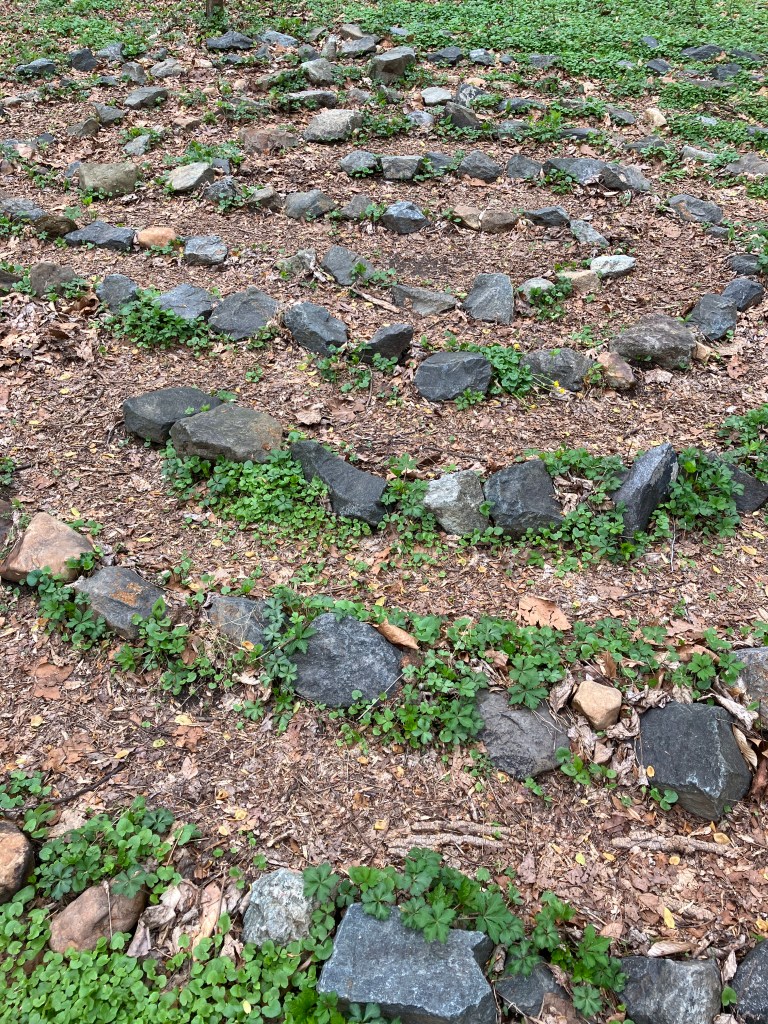
photograph (c) Katherine Brown
And the LORD said to Moses, ‘Go up to me on the mountain and be there. And I will give to you the tablets of stone and the instruction and the commandment which I wrote for their teaching.’
Exodus 24:12 [my translation], from Exodus 24:1-18 [NRSVUE] *
There’s a labyrinth in the woods where we walk. It doesn’t seem to be an official installation; no park signs herald its presence. We noticed it a few years ago, probably in winter or early spring, some time when the brush nearest the trail had died back enough that it could be seen. Stones are set in an irregular circle, within which a way is marked. The path starts at the edge, seems aimed directly at the center, then loops back and out, then in again. It’s a little labyrinth, really. Two or three wide strides would carry me entirely across it. Instead, I make my steps small enough to fit in its bounds. I follow the path toward the center, am carried back to the outer edge, then curve around in again. I walk a weaving back and forth, in and out. I hear the breeze rustle last season’s leaves and the creek run over rocks nearby.
Labyrinth progress, walking and reading: in towards the heart, then curving away. Overwhelming theophany, divine summons — all of this has happened before. Already the LORD invited and the people committed to do all which the LORD had spoken (19:1-8). Already the LORD came in cloud thick as kiln-smoke, in thunder and lightning and a trumpet that set flesh to trembling, and Moses, called, went up the mountain and talked with God (19:16-20). Exodus 24 reprises the antiphony of divine speech and human assent: the people promise ‘to do’ and ‘to hear’ (24:7); they are blood-bound in covenant (24:8); and the elders go up and eat and drink in the presence of a shining blue, smooth as pavement and clear as light (24:9-11). They have left Egypt; they are at the mountain. The act of encounter seems complete.
How, then, to understand the LORD’s further invitation to ‘Go up to me … and be,’ the promise of more to be given, instruction written on stone, purposed for teaching (24:12).
Chronological logic may suggest that this invitation is told out of order, came back before ‘all these words’ were declared by the LORD.** Yet maybe chronology is not the primary logic in the narrative. The looping back of the story may be a reminder that seeming completeness is not the same as complete. That Moses is — we are — summoned to further encounter, and encounter again.
The LORD says to Moses, ‘Go up to me on the mountain and be there. And I will give … ’ — promising Moses further gift. Summoning Moses to be in ongoing expectation.
To be in expectation is to recognize that what already is is partial. It is to resist the mistake of conflating our kingdoms with God’s, of claiming our constructions of power and identity as ultimate. To be in expectation is to know that all our going has not yet brought us to the completeness of it all. We suffer still the travails of empire and of wilderness, and we impose them on others and on creation itself. Crises continue, and none of them are new, and all our going has but led us back to the same ground, even the same trenches, newly named but familiar underfoot. It is not that we have never seen God flaming atop a mountain; it is that we mistook that flame for fulfillment. As if our own experience has already encompassed all that God has promised to work. The LORD’s invitation to go up, to be, to be given more reminds us that what is is not what is to be.
There’s also this: the LORD says to Moses, ‘Go up to me on the mountain and be there.’ God is not calling Moses to some divine waiting room (Moses flipping the pages of an outdated periodical till he is seen and handed the scrip for wholeness) but even in a state of expectation, to be in the presence of the glory of the LORD tenting on the mountain in fire and in cloud (24:15-18).
We’re not just waiting for God’s will to be done on earth as it is in heaven. We’re called to present ourselves to God’s presence even in this state of aching expectation of God’s further gift.
I walk the path towards the heart of the labyrinth, am carried back around the outer edge, then in again, and out until, having walked to the center, I pause, then step in faithfulness to the path’s guiding back out again. To resume walking on the woods trail, beneath the trees and beside the creek. Reminded to be in expectation, reminded — even in ache of brokenness — to persistently listen for the invitation to go up to God and be.
Labyrinth progress, walking and reading: in towards the heart, then curving out for further return.
* The lectionary lists this text for Transfiguration Sunday, the transition into Lent. I’ve been circling towards a center and away again, and continue weaving a way into the Easter season.
** Robert Alter translates Exod 24:1: ‘And to Moses, He had said — ’ using a pluperfect to suggest the slipping of the sequence. [Robert Alter, The Five Books of Moses: Translation and Commentary (W.W. Norton: 2004) p.455].

 Prudent Graces