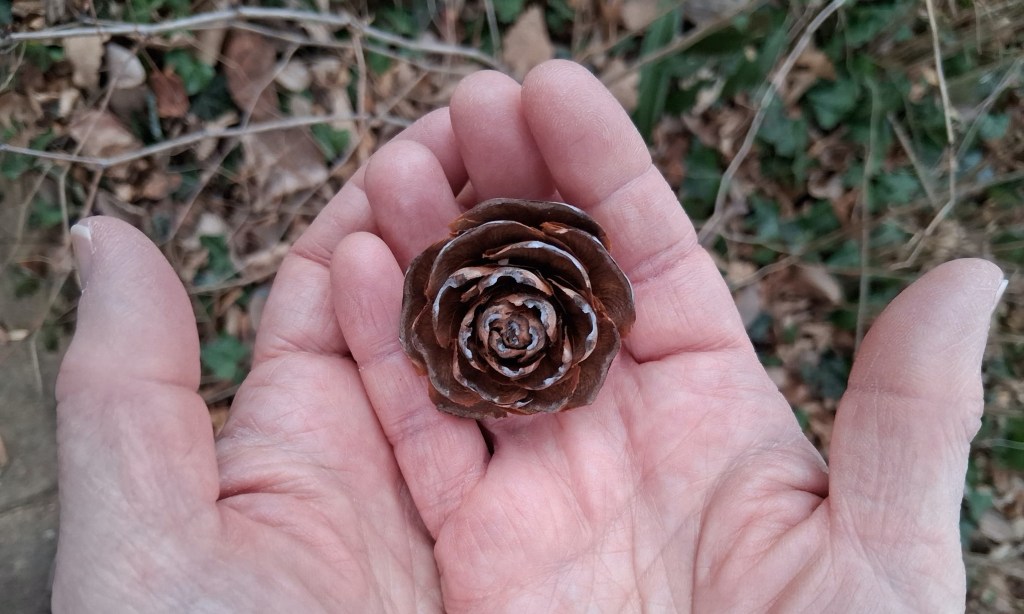
Parable

(c) Katherine E. Brown

In July, 2023, I found Jesus on my kitchen floor. Literally. I’d just unpacked the groceries into fridge and cupboards and basement pantry, then bent to gather and stow the reusable bags strewn about the kitchen, and saw him lying there on the green and white tiles. Tiny Jesus. I picked him up. He was made of some sort of laminated cardboard. Posed with arms outstretched, feet in first position, hands and feet inked with red stigmata. Haloed head tilted slightly to the side, dark hair lank on his shoulders, great wide eyes of an Orthodox icon. I looked at Jesus lying there in the palm of my hand and wondered where he’d come from. Fallen out of one of the grocery bags? (Unexpected literature has landed in my grocery bags before.). From a recent wedding attended? (I hadn’t remembered adding any prayer cards to my purse.)

I know exactly when I found Jesus because I was so struck by the unexpected encounter that I texted a photo to husband and daughters, and to my seminary sisters, and wrote about it in my journal. It had been a hectic season, with multiple moving parts meshing imperfectly, and I felt more aware of busyness than blessing. I was a bit weirded out to find Jesus on my kitchen floor — those eyes! those bleeding hands and feet! At the same time, I was a bit delighted to think that I went out for groceries and ended up encountering Jesus in my own kitchen. Little laminated Jesus lying on the floor. But Jesus. I tucked him into the pocket at the back of my journal and every so often took him out to hold and look at. Jesus and I gazing at each other. When that blank book was filled, I moved him to the pocket of the next, and then the next after, until I bought some books without pockets, and then left Jesus on my desk, for his own safety.

Sometime last academic year, I saw that the middle image had dropped out of my key-charm. The cross-shaped charm had been a gift from a colleague. The cross was bigger than any individual key on the ring, and the whole was a difficult fit in the small bag I carry. (The key-ring-and-cross fit more easily before I also carried a cell phone, which gives some indication of how long I’d had the key ring and charm.). That said, I liked the heft of the cross in my hand (if not its fit in my purse), and when I saw its center was missing, I was dismayed. I went back out to the car, looking around the driver’s seat, reaching my hand into the creases, bending low to look on the floor. I checked the other car too, just in case. I did not see the center anywhere. For a few weeks, I left the cross charm on my key ring, then decided that it was silly to spend purse space when its center blank seemed to gape absence whenever I glanced at it. I removed the cross from the ring. It was, I admit, a lot easier to snug the keys into my bag. I appreciated the convenience.

This morning, I again came across the key-charm with its missing center. Why am I keeping this? I wondered. Then I thought Wouldn’t it be funny if the little laminated Jesus could fit in the empty center? Maybe I could trim and fit him in. I looked through my desk and found the Jesus, placed him in the center of the metal cross, and realized Oh … oh … This empty space is the place he’d come from. I set him in the outline, pressed slightly, then ran my thumb over the whole. The surface felt smooth. The fit was precise, even to its depth.

A parable cannot be reduced to any single meaning. Nor can this two year sequence of finding and losing and finding again. I might dwell on the shock of that initial encounter in the midst of everyday, an unexpected, weird, delighting, welcome right there on my kitchen floor. I might be stuck instead in the rueful realization that I hadn’t recognized the kitchen-found Jesus as one I’d carried for years — he looked so unfamiliar there on the floor — nor that I had carried the key-charm for months after without seeing that its center was missing. I might pause on the added thought that without that center, the key-charm didn’t seem worth carrying anymore.

For now I’ll rest in the reunion of the two pieces into a single whole. Find some glue to restore the charm securely, then attach it again to the ring. Yes, the whole will take up more space in my small bag. I’ll have to arrange things carefully each time, if they’re to fit. Do it, that the inconvenience of the matter may become its own parable. Re-enacted every time I take out my keys remembering, now, to look for the center image present.

Sunday Morning Balcony Prayers

photograph (c) Katherine Brown*

Sunday mornings when I can, when there is time between staff’s pre-worship meeting and worship itself, when there is no class to teach or other meeting between, I go up to the balcony and I sit in the highest, farthest-back pew, and I look out past the rows in front of me, and the balcony rail, over the sanctuary below, and I pray.

Sometimes my prayers are worded. A list of names, of needs, of thanks. A petition that there will indeed be worship in this place, and that I may know it. Sometimes my prayers are wordless. A deliberate setting aside, an attempt at stilling myself, to this particular present, this particular place. The cream-white walls of the sanctuary; the shallow curve of the ceiling; the stained glass in the far front wall.

Sunday morning balcony prayers.

In the chancel below, the choir rehearses to piano accompaniment. The head usher refills the oil in the tall candlesticks set on the altar. Someone else maneuvers a long pole to open the high-up shutters on slender side windows. Now the sanctuary is less shadowy, more light. In the balcony, the AV team opens the console and begins setting up.

I am in the highest, farthest-back balcony pew, slightly apart from all the preparation that continues apace, looking for stillness in the pen on the page. The piano drops out and I pause my pen to listen. The choir sings, ‘Here I am to bow down. Here I am to worship.’ Hear the harmony, giving the melody line richness and depth. Think of all the parts that move, the parts in which we move. Move towards one another, towards that which is other entirely.

I sit and I listen and look straight ahead. The far wall seems to recede as I stare at it, growing slightly smaller and more distant … and the space between, the sanctuary itself, grows bigger, as if it could hold the world. As if it does.

I think of other spaces, other sanctuaries. Flying my bike down the hill and along the nearby line park. The trail curving with the creek and between the trees which stretch so tall, their green canopy a sanctuary ceiling above. Joy in this flight, this path, this place. The amber-watered creek. The marshaled trees. The blue sky. Others also ride and walk; they push strollers and hold leashes, and their presence is part of my gladness. Crows caw roughly and robins chirrup frantically and that loud, clear-water warble is the song of the tiny wren. We are all here; here is all of ours. Life not as possession but as participation, membership, movement.

Back to the balcony. No seraphim-sung Holy, Holy, Holy (Revelation 4:8). People’s voices, here on earth; human bodies moving. Choir now rehearsed. A choir member waves to me (I am apart but not invisible!). The AV team runs mic check. All of these strands being gathered together. Woven into worship. Here. In other churches, other places. None of this mine. All of this ours as we are invited in. Members in the movement and the music.

Lay my pen down. Close the book and fold my hands in my lap and be. Be spun. To be woven again into the whole.

*I waited to take the picture until the path was clear of walkers, bicycles, and chipmunks.

Listening to the Wind*

crossing the Bay, Oct. 2000; photo by Katherine Brown

The wind’s a wild one tonight.  It whistles and roars. The halyards rattle and clang against the mast.  The boat rolls and rocks.  It’s not especially comforting, the sound of that wind rising and rising and rising.  The boat seems very small to be afloat in such a huge and solemn sound.

We are anchored in Reed Creek — ‘A bit tricky to get into that following breeze,’ Paul had said as we bounced up the Chester River.  Breeze indeed.  It was bona fide wind by my definition, blowing us along at seven knots — even with two reefs in the main — and whipping the river into a foamy chop.  The girls, five and two, had started the sail in the cockpit with us, but then the wind rose and the temperature dropped sharply, and they retreated below.  Elizabeth unpacked coloring books and crayons for them both.  Paul and I took turns going below to put on more clothes, layering on everything we’d packed against the windy, bright cold.  After a while, the girls gave up coloring and rolled themselves in their sleeping bags, foot to foot on the wide settee, half-dozing, half-enduring the wild ride up the river. 

Now, anchored in the creek, we’ve all retreated from the cold cockpit.  The computer voice on the VHF weather channel says it may dip below 40, frost warnings inland.  We are crammed into the tiny cabin; tumbling over each other as I prepare dinner.

‘This is the best part,’ Elizabeth says, ‘all close together eating dinner on the boat.’

After dinner, Paul reads the girls a story.  In the middle of it, Margaret rolls off his lap, curled up like a little hedgehog and, surprisingly, soundly asleep.  Elizabeth is awake and helpful as we maneuver Margaret into a fresh Pamper and sleeper and bed.  I look at my big girl and smile and say how glad I am to have an adventure with her.  She looks at me and smiles back but doesn’t reply.  She seems slightly puzzled at the thought.  I wonder if this actually is an adventure to her.  She brings the same casual intensity to this boat, the real one, as she does to her pretend cruises at home, sailing the coffee table on the bounding rug, wearing a real life jacket and chatting with imaginary friends from books.  Burt Dow and the Giggling Gull are right there with her as she sets out in the Tidley Idley to rescue Little Tim and the Old Sea Captain. Those are her adventures, not these real outings on the Bay.  What she likes about the real boat, I think, is the intimacy, not the adventure.  She has the people she loves the best in the world right to hand, literally.

In the marina last night, we saw a boy trailing his dad back toward their boat, talking nonstop all the while.  ‘I like the boat, Dad.  I mean, it’s not like home.  There’s a lot of different things to do at home,’ the boy had paused, considered.  ‘And, well, actually, there is nothing to do on the boat.  But you and me and Mom, we are doing it all together.’

Still the boat rolls.  The low banks of the creek are not much protection from the wind.  It rises and roars, and the boat quivers accordingly.  The girls are asleep.  Paul and I are awake listening.  My eyes are dry and tired:  too much sun, too much wind.  But I am awake because of the wind’s ceaselessness and because of the girls’ trusting sleep.

Paul goes on deck again to make sure the anchor is holding, and that the rode isn’t chafing.  All is safe, despite the sound.  I go to close the open hatch against the cold and, glancing up, am caught instead by the sight of the round white moon shining through the moving, broken clouds.  I am held by its brightness and by their motion.  Paul comes below again.

‘Did you see —’

‘The moon,’ he says.

The stricter discipline of small-boat living creates a wider quiet in my mind.  It is not a deliberate refocusing but the natural result of embracing a more immediate responsibility and a closer connection to the world around.  I plumb more deeply where I am, what this is.

Rising wind.  Flying cloud.  High white moon.

I am surrounded by the water.  Together with my husband and my daughters right to hand.  Rocking on the water, listening to the wind.

*essay originally published in Chesapeake Bay Magazine, Jan. 2003; cruise taken Oct. 2000. The emotions associated with being on a small boat on a wide water in a wild wind are not limited to that literal circumstance — which is why I chose this essay to blog now.

Recognizing Joy*

Boats anchored near St. Michael’s, 2017; photo by Katherine Brown

The bliss of boating is how quickly you are very far away and how connected you are to everything around.  We have shipped not only our lines but, for a time, our workaday world.  We are sailing across the Chesapeake in a 30-foot Cape Dory, chartered out of Annapolis, now sailing to St. Michaels.

It is a chilly day, drizzly and dim.  Paul has on his oilskins; the girls and I are in slickers.  Elizabeth is three, a gallant, gay sailor-girl in a bright orange life-vest, a too-big green slicker, a purple hat and bright blue rubber boots. Her braids curl with the damp.  She leans over to watch the waves and hums happily to herself.  ‘The water is like Play-Doh,’ she says. ‘It has fingerprints in it.’  Margaret is four-and-a-half months, a snug bundle tucked on the floor of the cockpit.  Her little face is framed with the hoods of two jackets; her hands are inside her sleeves. She waves her arms for a while and smiles at us, then slips off into sleep, in a small boat on a wide water.

We arrive in St. Michaels before dusk and anchor in Fogg Cove.  The maritime museum and its Hooper Strait Lighthouse are behind us.  The velvet green lawn of the Inn at Perry Cabin is before us.  We’ve been in St. Michaels before; we’ve looked at this water from those shores.  But now we are seeing the land from the Bay.  It’s an unfamiliar view of a familiar place, and we relish the unexpected charm of the known made strange before turning to chores — changing damp socks for dry ones, heating chili for supper.  We hear the chime of church bells and a clock striking and the honking of geese overhead.  The two girls are in the V-berth; Paul has cribbed it in so neither can fall out.  Elizabeth coos, ‘Go to sleep, Margaret.’ Soon we hear them snoring, and we look at each other and smile.  Paul checks the anchor light. ‘Katherine, come.’  In the dark, a swan is swimming by.

Annapolis to St. Michaels, St. Michaels to Rock Hall, Rock Hall back across the Bay.  A wonderful run:  the wind steady and strong, we on a beam reach.  The main is up, and the jib, and the only sounds are the creaking of the lines, the squeaking of the wheel, and the slap of the waves against the hull.  The sky is blue but cluttered with clouds.  We sail past the Baltimore Light.  We sail into the Magothy and past Gibson Island and past Dobbins Island.  The light is growing quiet by the time we put the engine on; pale, green beams shine through the clouds onto the shore.  We motor on in search of an anchorage, sliding around a curve and into a quiet secluded little cove.  A wooded shoreline, the trees touched with russet, just starting to turn.  A few houses, with docks and boats.  No one out but us.

Our last night aboard.  We have beef stew and the last of a cheap bottle of wine.  The light grows clearer and more golden.  Clouds lit in peaceful glory.  We take mugs of milky coffee back on deck and watch the fading of the light.  The water very still, reflecting the pink and blue of the sky.  The highest clouds are lit coral-pink by the sun, the lower clouds purple-grey.  We see a great blue heron, here a screech owl, listen to the fish splash and see the ripples they make, circles that catch the light.  Margaret dozes in Paul’s arms.  Elizabeth leans into my knee and sighs and says, ‘This is very nice.’

The morning is pearly:  cloudy at dawn, then clearing slightly for the sun, mist rising off glassy water.  Elizabeth climbs into the still damp cockpit.  ‘Elizabeth!’ we call. ‘Come back down — it’s still wet out there!’  ‘I’m looking at the world,’ she tells us matter-of-factly.  ‘It is very beautiful.  Did you know God made the world?’  Paul and I look at each other, then turn to see the world with Elizabeth.

We bundle the girls again into sweaters and life vests and hats.  Margaret is in a jolly mood.  Elizabeth is happy winding a short bit of line around a winch.  We leave a curve of tiny bubbles as we motor slowly out of the cove and into the broader river.  The world here is all pearl.  The light is a suffused, pale, creamy grey.  The water is gently rippled glass, carrying in it the shapes and colors of the clouds above.  Water and sky match, endless and shining.  And in this spell-world, our small boat is caught between gleaming oyster sea and cloudy oyster sky.  We are connected to familiar things in unfamiliar ways, and recognizing joy.

* Another old essay revisited; this an edited version of ‘Recognizing Joy’; originally in Chesapeake Bay Magazine, April 2000.

Learning to Read*

photo by Katherine Brown: BHS open to Genesis 22

The book arrives two days after I order it online. The UPS man drops it off, bangs twice on the door and is already halfway back down the walk when I retrieve the package. I open the box. The book slides out into my hand. It is a small, heavy volume with a red-brown cover: Biblia Hebraica Stuttgartensia. I riffle through pages that still cling to each other. The print is small and squared with tiny flourishes and dots. It looks random, not like letters. It takes faith to believe that these shapes can be read.

The first morning of class, we chant the alphabet through: “alef, bet, gimmel, dalet.” We are all seminarians. We are also social workers, teachers, headhunters, lawyers, associate pastors. We are Baptist, Episcopalian, Methodist, Pentecostal, Presbyterian, Reformed Church of America and United Church of Christ. We are single, married, divorced and widowed. Megan is pregnant; Ann’s husband is in Iraq. We are 11 women and three men gathered for six summer weeks at Wesley Theological Seminary to learn Biblical Hebrew.

I spend the first night murmuring the letters, copying them until my arm aches. The next day we meet the vowels, the tiny dots and dashes generally placed under the letters. We sound out words. We dive into translating texts. I struggle with the shapes and sounds washing over me, unable to imagine them ever resolving into meaning. “Trust me,” the professor insists briskly, “You’ll get it. In two weeks you’ll be reading this page.” I am overwhelmed, as in a wave, swirled head over heels until I’m not sure which way is up, dumped sandy and spitting, eyes streaming, on the shore. And then the next wave is along. No sure footing, no knowing how to swim under and through in this wide sea.

“Why are you studying Hebrew?” my husband asks. Even in this first week I can tell him.  Already we have glimpsed the wonderful and terrifying breadth of the language. The noun that means “words” also means “events” or “actions” — speaking twined with doing. The verb that means “to be” also means “to become” or “to happen.”

We learn to parse verbs. Hebrew verbs carry their own subject an object in the affixes and suffixes attached to the three-letter root.  We learn to peel away the extra letters, to add back the missing, to consider again the whole.

I learn to read with my tongue, as well as my eyes. Sometimes this doing — reading aloud, involving my body as well as my mind — leads me to understand what I think I do not know.

I start to recognize some of the words. The four-letter word that English Bibles translate as “the LORD” is one of the easiest to see. Faced with a new passage I look first for this word; this leaves that many fewer words to translate. Scholars suggest that this Tetragrammaton is derived from the verb root “to be, to become, to happen.” The very name of God, then, encompasses not just static perfection complete and achieved but the causing yet to be, creation yet becoming.

Week after week we take quizzes. Each time my initial response is a flight of panic — the wave curving over me again — how can I tell the meaning of so many Hebrew letters? (No longer do I doubt that they hold meaning, only my own ability to access it.) I limit my focus.  Attentive discipline and wild flights of try-this, and word by slow, abiding word the text emerges from the murk.  I catch echoes of the English I know, but the familiar stories are given new and true force in their unfamiliar guise.

We learn grammatical rule after rule, each of which seems compounded with as many exceptions. (In intermediate Hebrew, we joke, the professor will reveal that there really are no rules.) The patterning is apparent but elusive, as much art as science. Slowly we start to build a sense of what is present and must be peeled away; what is missing and must be added. We are not memorizing the language but we are beginning to internalize it. Not yet swimming, but entered into the rocking water.

The class picks up speed. We are getting through entire chapters — although still, the occasional selection of wrong verb root results in a Mad Libs-type translation. We are giddy, enthusiastic, frustrated, amazed. One by one we dream Hebrew: dancing letters, difficult passages. We design a T-shirt with the legend in Hebrew.

The final exam is three hours of translating a passage we’ve not seen before. When we finish we gather on the hill for a picnic — a half-planned potluck with boiled eggs and falafel, pita and hummus, just-picked tomatoes. We stand in a circle, holding hands, hearing the blessing in Hebrew. Baruch atah Adonai, Eloheinu melech ha-olam. Blessed are You, Lord our God, King of the universe.

I didn’t learn to read Hebrew in six weeks. I learned that I shall be reading this sea for the rest of my life, even knowing I will never understand it all.

*Another throw-back post, in honor of the semester starting next week. This is a slightly revised version of the essay run in The Washington Post as ‘Taking the Plunge into Biblical Hebrew,’ Aug. 30, 2004. Then I was the student. Come next week, I am again the instructor, for the first time online.

Running Blind

Preparation for fall teaching — multiple classes, institutions, and online platforms — is keeping me from writing weekly posts. Rather than let this blog go entirely dark, I thought I’d republish essays originally printed elsewhere.

This originally appeared in the Sept. 2004 issue of Chesapeake Bay Magazine.

Fog off the Miles River; 2017; photo by Katherine Brown

I am crouched in the bow of the boat, shivering in the chilly damp, peering out into a surrounding blanket of white, trying to find our mark.  Stop thinking metaphorically — this is a literal fog. Keep your eyes open; keep looking.  As hard as I work to keep my attention focused, though, a part of my mind clicks separately.  So, this is what it is to be wandering blind.

We had waked to pearly gray fog obscuring the shores of the small cove where we’d anchored.  The trees on the nearest bank were barely visible; those opposite were totally hidden.  We waited out the morning, pleasantly idle at anchor.  The first white spot of sun showed around ten; it took another hour to burn through the fog and warm the cradle of our cove.  We lifted anchor around 11 and motored slowly out of the creek.

The sun shone hazy white and warm on the smooth ripples of the South River.  We went slowly, in no rush.  We were headed to the West River — barely a morning’s ride away.  As we approached the mouth of the river, just past Selby Bay, I went below to get lunch.  I came back up a few minutes later to find that the fog had rolled back in.  Blown in from the open Bay, perhaps.  We had just come up on a mark, and even as I watched, the fog started to spread shreds of white between it and us.  Paul quite matter-of-factly said, ‘Hold her here while I go below and check my compass course to the next mark.’  We have no GPS or radar, so he works with compass and parallel rule and paper charts.

So here we are in the fog again, deprived of the sun’s warmth.  Paul is back at the wheel, I’m at the bow, staring into the thick nothingness.  Eight-year-old Elizabeth stands in the cockpit to see over the cabin; she calls out crab pots in our way.  Five-year-old Margaret looks behind; she calls out crabpots in our wake.  We pick our way slowly forward.  The fog is thick gray-white.  The water is gray with odd black gleams.  All we can see is this circle of soft fog, this circle of strange water glinting like fish skin.  Another boat motors slowly toward us out of the fog then passes away into it again.

Paul heads for where the mark should be.  He has plotted a course between the marks which are closest together rather than those which are linked most directly to our destination.  We hit the first few marks dead on.  The wind is light, and Paul’s course is true.  One lays more to starboard than it should have, but close enough to spot.  Paul shifts course slightly and keeps going slowly forward.  The girls call out in excited voices.

And I, crouched and cold, look at the strange sea.  My mind beyond attentive eyes wanders still to simile and metaphor. Remembering an older woman who once told me, ‘It’s not knowing the answers.  It’s learning to live with the questions.’  So this is what it is.  This steady procession from mark to mark to mark even as we study the surrounding shining for signs and a wider view.

The circle of fog does not surround us evenly — sometimes it draws close on one side and seems broader on the other.  I look not only for the marks but also to try and hold this unearthly sight.  To try and hold this weird sense of being surrounded, suspended and separate, outside all normal space and time.  We have no view of the farther shore.  We can see only fifty yards to one side, a hundred toward the other.

I wonder whether I am starting to perceive an intimation of blue above.  But we are headed toward the sun, and the fog is thickest and most dazzling white at this angle.  Impossible to see anything ahead.  To the right?  No … Yes!  Definitely a line of shore somewhere between the fog and the water.  A reddish-sandy shore at the base of a cliff. The water still glinting sharkskin and the fog soft white, yet between them, the welcome sight of Dutchman Point and its sheltering, white-winged building.  The autumn-rich tones of the grass and trees and the overlaying vagueness of the fog look like a painting by an old master.

As the fog burns off further, we can see above it towering cumulus clouds, white on white, lit with just enough blue to be blinding.  The next mark is for the Rhode River, and the next after that for the West.  The fog is mostly lifted, here, though we can see a hint of white, still, behind us toward the Bay.  I go back to the cockpit.  Paul and I look at each other with unvoiced relief.  The sun is warm.  The view is lovely, shore and houses and boats together.  The rest of the trip is easy.  Soon we are back in the slip, unloading and cleaning up for the drive home.  All the normal chores.

Still, though, I can close my eyes and see that fog.  The thinking shining white, the weird glinting water.  Still, in my mind I hold that since of blindness made visible as we traveled strange water toward home.